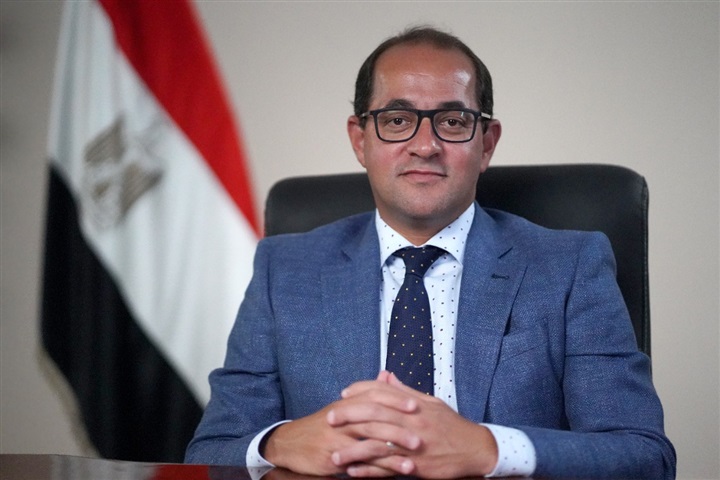
Medal of Respect.. Minister Ahmed Kouchouk: A Mission with No Margin for Error
Sunday 16/August/2026 - 10:31 PM

Khaled Ali
Managing public finances in times of turmoil is not merely an exercise in accounting; it is the first line of defense in safeguarding the stability of the state. At a time when news moves at breakneck speed, genuine achievement alone deserves our attention. Just as society needs criticism and accountability, it also needs a culture of appreciation, for recognizing effort and success is no less important than correcting mistakes.
It is from this perspective that this weekly feature was conceived: to shine a spotlight on an Egyptian figure who has made a tangible impact in his or her position, in the belief that a person’s worth is measured not by the office they hold, but by the difference they make.
In this issue, the choice falls on Dr. Ahmed Kouchouk, Minister of Finance, who bears responsibility for one of the ministries with the greatest impact on the lives of Egyptians—and perhaps one of those most exposed to pressure. Every financial decision affects citizens in one way or another, and every shift in the global economy quickly finds its way to the Finance Minister’s desk. He is therefore required to manage an extraordinarily complex equation: preserving the stability of the state, stimulating the economy, and continuing reform programs without undermining society’s ability to remain cohesive.
Dr. Kouchouk did not assume responsibility under ordinary circumstances. He took office at a time when the world was experiencing successive economic disruptions, rising global interest rates, and geopolitical tensions that have cast a shadow over trade and investment, in addition to the continuing pressures facing emerging-market economies, including the Egyptian economy. Under such circumstances, managing the Ministry of Finance is not merely an administrative task; it means managing one of the state’s most important lines of defense in safeguarding stability.
Fiscal policy is not simply about preparing the state budget or announcing revenue and expenditure figures. Rather, it determines the state’s ability to move forward with its projects, meet its obligations, finance social protection programs, attract investment, and preserve the confidence of markets and international financial institutions in the Egyptian economy.
Since assuming office, Dr. Kouchouk has adopted an approach based on strengthening fiscal discipline while sustaining economic activity—a balance that is by no means easy to achieve under current conditions. The objective has not been simply to reduce figures or improve the appearance of economic indicators, but to build a more sustainable policy that gives the Egyptian economy greater capacity to withstand crises.
He has also paid clear attention to rebuilding the relationship between the Ministry of Finance and the business community by introducing packages of tax facilitation measures, simplifying procedures, and broadening the tax base by integrating the informal economy rather than increasing the burden on those who are already compliant. This sends a message reflecting a shift in the philosophy of fiscal management—one founded on partnership before collection, and on what the Minister himself has repeatedly called a “partnership of trust.”
This has not been separate from the state’s broader drive to expand the private sector’s role in leading growth. Investors do not seek incentives alone; they also look for stability, clarity, and swift procedures—all matters at the very heart of fiscal policy.
At the same time, efforts have continued to manage public debt more efficiently, reduce financing costs, and achieve a primary surplus. These issues may seem far removed from citizens’ everyday concerns, but they form the foundation upon which the state relies to maintain its capacity to spend on education, healthcare, infrastructure, and social protection without compromising economic stability.
The Ministry of Finance may well be one of those ministries whose successes people rarely notice until the state faces a crisis. The results of prudent financial decisions do not become apparent in a day or a week; rather, they are gradually reflected in the economy’s resilience, investor confidence, market stability, and the future of generations to come.
For this reason, success in such a position is not measured by the number of conferences held or statements issued, but by the state’s ability to maintain its fiscal balance, continue implementing its development plans, and confront global changes without losing its sense of direction.
There is no doubt that the road ahead remains long and that the economic challenges are far from over. Nevertheless, what has been achieved thus far confirms that the management of the state’s finances is proceeding according to a vision aimed at sustainability rather than temporary solutions, and genuine reform rather than quick fixes.
His receipt of the 2025 Best Finance Minister in Africa Award, as part of the African Leadership Business Awards, was nothing less than external recognition of a trajectory being closely observed both at home and abroad.
Perhaps what most distinguishes Dr. Ahmed Kouchouk is that he belongs to a generation of officials who combine technical expertise, executive experience, and an understanding of international financial institutions. This has been reflected both in his management of the Ministry and in an economic discourse that has become clearer in its communication with investors and markets.
His selection for this weekly feature, therefore, is not a celebration of office or title, but an expression of appreciation for an official who is leading one of the portfolios with the greatest impact on the state’s present and future. He is working at an exceptional juncture that demands precise decisions, long-term vision, and a conviction that economic stability is not an end in itself, but the foundation upon which development is built, jobs are created, and citizens come to experience the benefits of reform.
Ultimately, citizens may not feel the impact of every financial decision at the moment it is made. Yet history has repeatedly shown that strong states are not built on slogans, but through sound economic management that knows how to preserve stability while opening the way toward the future.