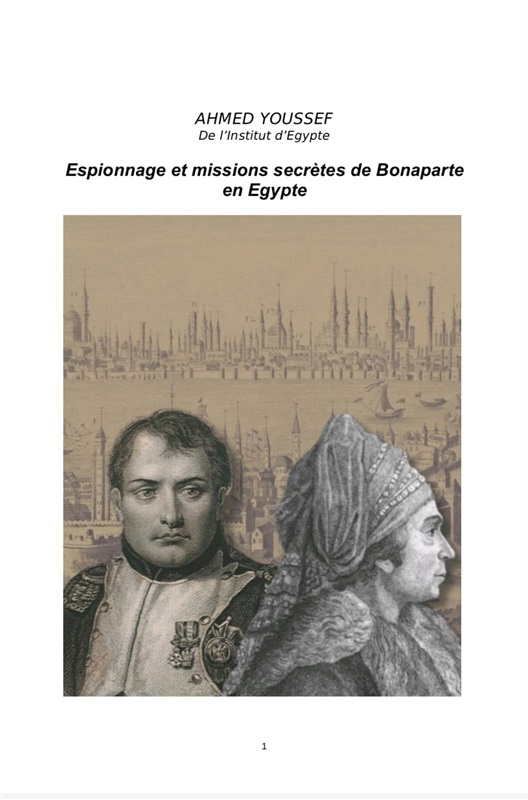
Dr. Ahmed Youssef to Deliver a Lecture on Napoleon Bonaparte’s Spies in Egypt and the Middle East at Paris’s 15th Arrondissement Town Hall on September 2
Tuesday 01/September/2026 - 01:20 PM

Dr. Ahmed Youssef
Today, the website «the reference» has the exclusive publication of an unprecedented study in the field of Napoleonic-era studies in France by Dr. Ahmed Youssef, the renowned researcher and member of the Institut d’Égypte, on the spies employed by Napoleon Bonaparte during his occupation of Egypt, and even after his armies were defeated and withdrew from Egypt in 1801.
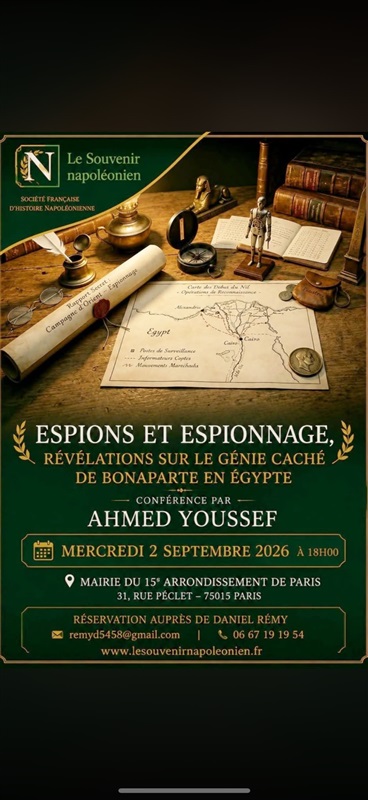
This comes on the eve of Dr. Ahmed Youssef’s presentation of the lecture at the Town Hall of Paris’s 15th Arrondissement on September 2. The lecture will be attended by the Egyptian Ambassador, Dr. Tarek Dahroug; Dr. Abdel Rahim Ali, President of the Center for Middle East Studies in Paris (CEMO); and a large number of French specialists in Napoleonic studies, foremost among them the prominent writer David Chanteranne, Editor-in-Chief of the long-established magazine Souvenir Napoléon, as well as a number of public figures in France, including Philippe Béra, President of the Engie Foundation for financing cultural projects and major exhibitions in France.
Along with the lecture, we also publish a brief account of the author, his academic career, and his scholarly works.
......................................................
“Napoleon Bonaparte’s Espionage and Secret Missions in Egypt and the East”
Dr. Ahmed Youssef – Paris
Dedication
To my dear friend Jean-Paul Duthion, Mayor of Orgelet, the birthplace of Officer Bouchard, discoverer of the Rosetta Stone during the French Campaign in Egypt.
This study is based on the orders issued by Napoleon Bonaparte to his spies, consular agents, and operatives entrusted with secret missions, as recorded in his extensive correspondence from Egypt (Fayard, Paris, Vol. II, 1,270 pages, 2005), which I had the pleasure of translating into Arabic in 2015. The Arabic edition was published in two volumes by the Institut d’Égypte, founded by Bonaparte in Cairo in August 1798, in cooperation with the Fondation Napoléon.
Years ago, the distinguished Cairo newspaper Al-Bawaba published a large collection of these orders in a series of installments that won the admiration of readers in Egypt and throughout the Arab world. This was the first time that subjects relating to the French Campaign had been published for the general public outside academic circles. I referred to this in my book:
Bonabarta, Napoléon, une passion arabe !
published in 2024, which achieved wide recognition among readers and the media in France and received a prize from the French Académie des sciences morales et politiques in November 2024. In the book, I also referred to the major role played by the newspaper and its then president, Dr. Abdel Rahim Ali, in bridging the gap between these difficult Napoleonic studies and the general public.
In the history of the Campaign in Egypt (1798–1801), the spy was the unknown soldier, almost in spite of himself.
As we know, espionage is by its very nature a secret activity. But secrecy was sacred to Napoleon Bonaparte. No one knew the secrets surrounding the preparations for the Campaign in Egypt except Bonaparte himself and the three members of the Directory government, and only rarely did he disclose them to a small circle of those closest to him. Nor should we forget his exceptional ability to maintain secrecy, which enabled him to conceal the destination of the formidable military fleet being assembled at the port of Toulon.
In a port such as Toulon, which teemed with British spies, Bonaparte concealed the name of Egypt in all correspondence concerning preparations for the invasion.
Initially, the correspondence referred only to the “Army of the Mediterranean,” and later to the “Army of the Orient.” Egypt was never mentioned in that correspondence until after the fleet had departed Malta. This explains the bewilderment of Nelson and his fleet, which sailed back and forth across the Mediterranean monitoring the preparations at Toulon without knowing their ultimate destination.
Bonaparte’s reverence for secrecy was almost a doctrine, and speed in carrying out secret missions was another doctrine: slowness was the enemy of secrecy. Between the issuance of an order in Paris and its execution in Toulon, Ajaccio, Genoa, and Civitavecchia, where the fleet was assembling, neither distance nor the languor of the Mediterranean summer—we are in April 1798—was permitted to hinder the transmission and execution of the order.
Consider, for example, the chronology of preparations for the Egyptian Campaign of 1798:
January 26: Talleyrand and Bonaparte meet and discuss the invasion of Egypt.
February 14: Talleyrand submits a memorandum to the Directory supporting the invasion of Egypt.
Shortly beforehand, he had received in Paris the French consul in Egypt, Charles-Claude Magallon (1741–1820), who gave him a report on the feasibility and importance of invading Egypt. The report, published in 1997 under the title Mémoire sur l’Égypte, was what prompted the Directory government to decide upon the invasion.
February 23: Napoleon submits a memorandum to the Directory arguing that an invasion of Egypt could be a viable alternative to invading England.
March 5: The Directory approves entrusting the Egyptian Campaign to Napoleon.
April 12: The Directory formally decides to establish the “Army of the Orient”—taking care not to mention Egypt—and places it under Napoleon’s command.
June 10: French forces seize Malta without fighting.
June 22: A proclamation informs the Army of the Orient that its destination is Egypt.
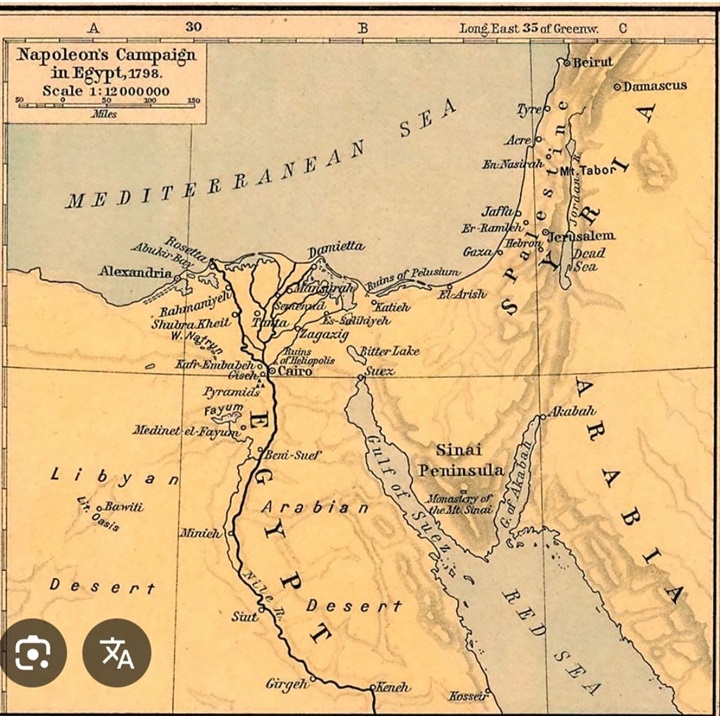
July 1: Landing at Alexandria.
Thus, secrecy was a decisive weapon in this military invasion, but it was also the product of a long French tradition of espionage in the East, dating back to the project presented by the philosopher Leibniz to Louis XIV in 1675 under the title Consilium aegyptiacum, with the aim of dissuading him from invading Holland. This text was appended to my doctoral dissertation at the Sorbonne in 1992. I later translated it into Arabic, and it was published in the Kitab al-Hilal series under the title The Philosopher Leibniz’s Project for the Invasion of Egypt, with an extensive introduction by the late, distinguished Kamel Zuhairi.
Let us now review Bonaparte’s most important spies in Egypt. Perhaps we should begin with the Baron (1733–1793), whom France sent before the Campaign itself as part of an old French project to invade Egypt dating back to the Crusades.
Baron de Tott: The First French Spy in the East
Following the Seven Years’ War between France and England (1756–1763) and the Treaty of Paris of 1763, which granted the English the greater part of the French colonies in the New World, India, and Senegal, French strategists returned to the old Egyptian project lying in the archives of the Ministry of the Navy, with the aim of cutting Britain’s route to India.
In 1777, Baron François de Tott traveled to Egypt to conduct reconnaissance on the ground and study the feasibility of mounting a large-scale campaign. He was required to identify the most suitable landing areas between Damietta and Alexandria, study the nature of the coastline and whether it provided cover for defenders, and obtain a plan and maps of Alexandria, its streets, walls, and the terrain surrounding it.
Under the cover of inspecting and reorganizing French consular offices and trading agencies in the East, de Tott traveled in the company of a man who would later play a major role alongside Bonaparte in Egypt: the interpreter and Orientalist Venture de Paradis.
Upon his return in 1778, he submitted a complete invasion plan to the Ministry of the Navy. He may therefore be regarded as the first genuine French spy in Egypt. His military plan was astonishingly precise, and his assessments of the existing political forces were often correct. The planners of the Campaign in Egypt drew upon Baron de Tott’s report and the observations of the dragoman Venture de Paradis, who would himself become director of the Campaign’s interpreting service and maintain close personal ties with Bonaparte.
Spies in the Preparation of the “Army of the Orient”
General Bonaparte was conscious of the importance of intelligence in the dangerous venture he was preparing in the East. On April 14, 1798, he wrote to Merlin de Douai, President of the Executive Directory, requesting the assistance of experienced individuals, including Piveron, who had worked for a long time in the service of Tipu Sultan in India, in the hope of sending him back to India to revive French contacts there.
While on his way to Egypt, and after taking Malta, Bonaparte considered using diplomacy to win over Ali Pasha of Tepelena, Pasha of Janina in Albania. He instructed his aide Lavalette to contact him secretly, record everything he said, and return with a full report.
Bonaparte arrived at Damanhur on July 8, 1798, and then at Rahmaniya on July 10. On July 11, he wrote to General Berthier, the army’s chief of staff, placing specified sums at the disposal of the generals to cover expenses for spies, couriers, and unforeseen expenditures: 2,000 francs for Desaix; 1,000 each for Dugua, Reynier, and Bon; 500 each for Vial, Dumas, and Zajączek; and 1,500 for Perrée, commander of the light flotilla, in addition to 3,000 livres for postal and travel expenses.
The postal service was of particular importance. If information was urgent or highly sensitive, orders were given to send it more than once and by different routes to ensure its arrival and also to verify that no one had tampered with the contents of the message.
The Organization of Intelligence in Egypt under French Rule
After entering Cairo on July 24, Bonaparte established, four days later, the “Administrative Commission” to inventory the property of the Mamluks, the Ottomans, and the consuls of states hostile to France; convert it into “national property belonging to the army”; collect contributions; and protect property. The commission included the eminent scientist Monge, Consul Magallon, and Berthollet, assisted by Jomard, Fevre, and Gallois.
Despite the scientific and diplomatic stature of the commission’s members, Bonaparte attached six intelligence and surveillance agents to it to ensure the implementation of orders in the six provinces controlled by French forces in Egypt. These agents were none other than young soldiers attached to his personal service, who owed their commander blind obedience and exemplary loyalty. This would later become a tradition followed by Napoleon Bonaparte in every intelligence operation: monitoring the movements of his spy and the official responsible for implementing orders—in other words, placing a spy over every spy or individual engaged in a secret mission.
Another Bonapartist method was never to entrust a foreigner with secret missions, nor even a Frenchman, except after numerous tests.
On August 4, 1798, Napoleon ordered General Murat to send a spy to Bilbeis and to report to him immediately upon the spy’s return with all the information he had obtained.
He was also extremely wary of strangers who persistently sought to join the army. In October 1798, he ordered that there should be no foreign officer on the general staff, nor any inexperienced French officer, unless his loyalty had been established.
The Spy Jean-Louis-Henri Picot de Moras
Picot de Moras (1768–1799), an officer in the engineering corps, was Bonaparte’s intelligence man par excellence, first in Italy and then in Egypt. He possessed an exceptional talent for military intelligence and topographical reconnaissance. Bonaparte allowed him freedom of movement and intelligence-gathering in Alexandria and Rahmaniya, and instructed his generals in the provinces to facilitate Picot’s mission and not interfere with his activities.
However, the Ottoman Empire’s declaration of war on France and the outbreak of the Cairo Revolt alarmed Bonaparte, making his intelligence apparatus more important than ever. Bonaparte therefore increased the intelligence budget. On November 14, 1798, he ordered that 3,000 francs be paid to General Reynier “for secret expenses.” We do not know precisely the nature of the missions undertaken by General Reynier, but this brings us to the case of one of Bonaparte’s strangest spies in Egypt: Bracevich.
Bracevich: Bonaparte’s Orientalist Spy in Istanbul
Louis-Michel-Damien Bracevich was born in Ragusa, Croatia, around 1770. Like many young men from the Dalmatian region who were close to Ottoman culture, he learned Turkish and Arabic in order to work as a dragoman in administrative offices, consulates, and European establishments in the East.
After Bonaparte’s fleet was destroyed by Nelson at Aboukir on August 1, 1798, Bonaparte became a prisoner of his own invasion in Egypt, cut off from news coming from France, Europe, and the Ottoman Empire. He then entrusted Bracevich with an extremely dangerous intelligence mission: to gather as much information as possible about the position of the Sublime Porte and about the Ottoman and British embassies and forces.
On October 30, 1798, Bonaparte ordered him to travel in the company of Ibrahim Agha, establish contact with the Turkish fleet, gather whatever information he could, and even wear Turkish dress if he was not already doing so. He also instructed an intelligent naval officer to observe everything without intervening, while another envoy was to approach the English admiral and leave him copies of some of the Egyptian newspapers published by the Campaign in Egypt, while attempting to extract as much information as possible about events on the European continent.
The operation was largely successful, and Bracevich returned with news from Istanbul. Yet Bonaparte’s suspicions of him never entirely disappeared. In July 1799, he ordered his arrest along with several interpreters. Bracevich later ended up in Algeria, where he died under mysterious circumstances on July 19, 1830.
Guibert: A Young Man for Secret Missions
The young lieutenant François-Fortuné Blouvier Guibert (1779–1799) was one of Bonaparte’s aides—or what we would today call a military courier—and died at the age of twenty in the land Battle of Aboukir on July 25, 1799. Were it not for the espionage missions conceived by Bonaparte’s strategic imagination, the name of this courageous soldier might well have been forgotten.
On November 16, 1798, Bonaparte issued him detailed orders to proceed to Rosetta, then board a vessel of negotiation—small ships flying white flags to indicate a desire to negotiate with the enemy—and meet the English admiral.
He was to give him Egyptian newspapers, attempt to obtain European newspapers from him, and, during the conversation, leak misleading information about French communications, forces, and movements. He was first to listen to what the English had to say about the Russians and Corfubefore responding to them.
Guibert succeeded in obtaining valuable intelligence from his meetings. Upon his return, he revealed to Bonaparte that Frenchmen in Alexandria had been communicating with the English without his knowledge. He even informed him that French soldiers had fallen into English captivity without Bonaparte being notified. Bonaparte angrily ordered the commander of Alexandria to be summoned and those responsible to be held accountable before military commissions of inquiry.
Guibert later took part in the fighting in Syria and fell in the land Battle of Aboukir. Bonaparte mourned him dramatically in his reports and letters.
Carlo Rossetti and Marco Calavaggi
Carlo Rossetti (1742–1820), former consul of Venice and Austria in Alexandria, was a prominent figure in the world of espionage and secret missions in Ottoman ports during the Campaign. He had built an extensive network of relationships and business interests in Alexandria, Rosetta, Cairo, and Suez, and maintained close ties with Murad Bey and his wife, Sitt Nafisa al-Muradiyya.
He had a large number of spies working under him in Egypt, the ports of the Middle East, and the Ottoman Empire. Among the most prominent was his fellow Venetian Marco Calavaggi, who became one of Bonaparte’s most important agents.
On August 1, 1798, Bonaparte granted Rossetti full authority to negotiate secretly with Murad Bey and conclude an agreement with him. However, the catastrophe that befell the French fleet at Aboukir weakened the French position, altered the balance of power, and caused the mission to fail.
Calavaggi, meanwhile, became an essential element in the intelligence network, to the point that Bonaparte later described him as “an agent of the entire French Republic.” He also participated in a mission to Wadi al-Natrun with a scientific expedition that included Berthollet, Fourier, and several engineers.
The Extraordinary Mission of the Clergyman and Astronomer Joseph de Beauchamp
On December 10, 1798, Bonaparte issued a brief order to the army’s general treasurer: “Place ten thousand francs at the disposal of Citizen Beauchamp.”
Joseph de Beauchamp was a clergyman, astronomer, and diplomat of the highest caliber. He had acquired extensive knowledge of the East through study, the learning of Eastern languages, and then practical scientific experience, as we shall see.
De Beauchamp arrived in Damietta on September 1, 1798, after a turbulent journey during which he fell into the hands of the English and was subjected to harassment by Bedouins.
He arrived in Cairo on September 6, and the following day delivered two formal lectures at the Institut d’Égypte, one on astronomy and the other on Istanbul, in the presence of Bonaparte, the general staff, scholars of Al-Azhar, and leading members of the Diwan. That same evening, he was appointed a member of the Institut d’Égypte. Bonaparte was deeply impressed by the man, his abilities, and his commanding presence.
Following numerous private meetings with Bonaparte, an extremely complex plan was devised under the cover of a mission to seek reconciliation with the Ottoman Empire. The true objective was for Beauchamp to reach Istanbul, gather precise information on the political and military situation of the Turkish state, contact the French consul imprisoned in the notorious “Seven Towers” prison, and obtain newspapers and news from Europe and the East.
In a lengthy letter dated December 11, 1798, Bonaparte ordered him to pass through Cyprus and gather information on Syria, the Russian fleet, English ships, Corfu, Istanbul, and the Turkish fleet. He was then to proceed to the Turkish capital, remain there for only seven or eight days, and return with a precise assessment of the Ottoman Empire’s political and military situation.
He also instructed him to send news to Damietta whenever an opportunity arose, and to dispatch a courier from Constantinople to Paris via Vienna carrying the information required by the government.
To ensure the mission’s success, Bonaparte wrote that same day to General Marmont, to Talleyrand, and to Yusuf Pasha, Grand Vizier of the Ottoman Empire. He then entrusted his aide Lavalette with supervising the operation until Beauchamp sailed.
But the winds do not always blow as the ships desire. The English intercepted the vessel carrying Beauchamp and sent him to the Ottomans in Istanbul, who imprisoned him in the Seven Towers prison together with Consul Ruffin—the very man Beauchamp had come to secure the release of—only to find himself sharing the same cell with him. He was not released until after the French army withdrew from Egypt in 1801.
After the Campaign: The Espionage Network Continues
After the army and the scholars returned to France in 1801, Bonaparte was unwilling to see his old Eastern dream, and Egypt, fall into English hands. The Campaign had demonstrated Egypt’s strategic importance in the regional geopolitical balance.
He therefore continued his policy of sending spies, envoys, and diplomats to the East; sometimes one man combined all three roles.
Prominent in this context was the Corsican officer Horace Sébastiani (1772–1851), who arrived in Alexandria in October 1802 and found the country in a state of civil war and conflict among the Ottomans, Mamluks, English, and emerging local forces—the notables of Cairo and Alexandria, the sheikhs of Al-Azhar, and merchants. He prepared a comprehensive report on the political and military situation, supported by plans and maps.
After his return, Bonaparte sent two official diplomats who left a profound mark on Franco-Egyptian relations: Mathieu de Lesseps, French consul in Cairo, and Bernardino Drovetti, French consul in Alexandria.
Mathieu de Lesseps was the father of Ferdinand de Lesseps, who would later become the driving force behind the project to dig the Suez Canal. He played an important role in Muhammad Ali’s rise to power.
Drovetti, meanwhile, became one of Muhammad Ali’s close associates and was also one of the greatest collectors of Egyptian antiquities, many of which he acquired by illegal means.
Among the most notable later secret missions was that of Colonel Vincent-Yves Boutin (1772–1815), Napoleon’s agent, who was sent on a secret mission to Egypt and submitted a detailed report on conditions there. His life ended with his assassination in Aleppo in July 1815, only days after the catastrophe of Waterloo, as though his life and fate had become intertwined with the life—and the Egypt—of Napoleon Bonaparte himself.
..............................
A Brief Account of the Author’s Life and Works
Dr. Ahmed Youssef is a historian and journalist well known to the French public and within French and European academic and cultural circles. He is a former adviser to the Egyptian Ministry of Culture and a member of the Institut d’Égypte.
The following is a list of his works published in France:
The Passion for Egypt: From Dream to Project, L’Harmattan, 1998.
Cocteau the Egyptian, foreword by Jean Lacouture, Le Rocher, 2001.
The Seven Secrets of the Library of Alexandria, foreword by Jacques Attali, Le Rocher, 2002.
Jacques Chirac and the East: France’s Arab Policy, foreword by Jean Lacouture, Le Rocher, 2003.
The Monk and the Prophet Muhammad: The Judeo-Christian Milieu in Mecca in the Sixth Century, foreword by Théo Klein, Le Rocher, 2008.
The Lighthouse of Alexandria: From Image to Imagination, Le Rocher, 2010.
Jean Lacouture: Across Mountains and Words, a Biography, Bayard, 2012.
Bonaparte and Muhammad: The Fascinated Conqueror, foreword by Jean Tulard, Le Rocher, 2003.
Our Orients, Dream and Conflicts: A Dialogue with Jean Lacouture, Le Rocher, 2009.
Louis IX, or Saint Louis, in Egypt, Orients Éditions, Paris, 2014.
The Pope Who Loved God: A Thousand Years of Misunderstanding, Dervy-Médicis, 2019.
Officer Bouchard, the Unknown Man Who Discovered the Rosetta Stone, L’Harmattan, Paris, 2021.
Bonabarta, Napoléon: An Arab Passion, Passés Composés, 2024. Winner of the Mogan Prize from the Académie des sciences morales et politiques, 2024.
Gustave Courbet’s The Origin of the World: An Egyptian Destiny, L’Œil du Mercure, Paris, 2025. Winner of the “Deux Rives” Prize, 2026.
Translations
Dreams of the Convalescence, the final work of Nobel laureate Naguib Mahfouz, foreword by Mohamed Salmawy, Le Rocher, 2003.
Bonaparte’s Correspondence in Egypt, two volumes, approximately 3,000 pages, published by the Institut d’Égypte, 2015, and subsequently serialized in the Cairo newspaper Al-Bawaba in 2018.
Decorations and Honors
Knight of the Order of Arts and Letters of the French Republic, 2004.
“La Marseillaise” Prize from the French National Assembly for his overall body of work and journalistic career, 2006.
Napoleon Prize for his play Sultan Bonaparte, 2024.