Putin Breaks Diplomatic Isolation as Trump Opens Door to Russia’s Global Comeback
Monday 02/November/2026 - 03:30 PM
Ahmed Seif El-din
Russian President Vladimir Putin is increasingly breaking through his diplomatic isolation, aided by a shift in Washington’s approach under President Donald Trump. Nearly five years into the Russia-Ukraine war, Moscow is expanding high-level international engagement while securing potential concessions from the United States, raising concerns among European allies about Ukraine’s future and the effectiveness of Western pressure on the Kremlin.
Putin Expands Diplomatic Engagement Amid Ukraine War
Putin intensified his diplomatic activities in Moscow over the past week, holding rare conversations with Finnish and Norwegian leaders and welcoming Qatar’s emir and Iran’s president to a gathering of gas-exporting nations.
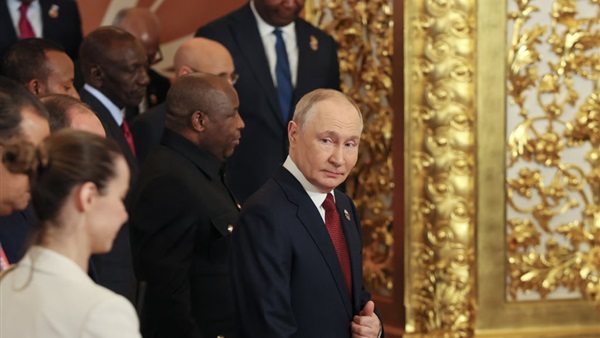
He also hosted African leaders at a Russia-Africa summit, promoting Russian technology and encouraging governments to strengthen oversight of social media platforms to prevent unrest similar to protests in France.
During the meetings, Putin promoted Russia’s alternative to Starlink while describing Elon Musk as “a brilliant man” and emphasizing Moscow’s continued contact with him.
The diplomatic offensive highlights Russia’s efforts to overcome Putin’s diplomatic isolation despite the continuing war in Ukraine and Western attempts to restrict Moscow’s international influence.
Trump’s Russia Policy Creates New Opportunities for Moscow
The Trump administration’s approach has emerged as a significant factor in Russia’s renewed diplomatic momentum.
Washington is reportedly considering lifting sanctions on Russia’s principal state investment fund. The potential move follows Trump’s agreement to import Russian diesel fuel and favorable remarks about Putin from US special envoy Steve Witkoff, who described the Russian leader as a humanitarian.
Stefan Meister, a Russia analyst at the German Council on Foreign Relations, suggested that Moscow is benefiting from developments beyond its expectations.
“In the Kremlin, I think they are really celebrating,” Meister said, arguing that Russia is receiving advantages regardless of whether it makes meaningful concessions.
The developments suggest that Putin’s diplomatic isolation could weaken further even as Moscow continues military operations in Ukraine without signaling readiness for major compromises.
Potential Summits Could Strengthen Putin’s International Standing
Putin is expected to travel to Shenzhen, China, in November for the Asia-Pacific Economic Cooperation forum, where a possible meeting with Trump and Chinese President Xi Jinping could elevate Russia’s diplomatic profile.
A separate opportunity may emerge in December, when Putin could attend the Group of 20 summit in Miami following an invitation from Trump.
Neither potential meeting guarantees a diplomatic breakthrough. However, participation in major international gatherings alongside American and Chinese leaders would represent a symbolic victory for Moscow after years of Western efforts to isolate the Russian president.
Ukraine Faces Growing Pressure as US Relations Deteriorate
Russia’s diplomatic gains coincide with increasing tensions between Washington and Kyiv.
Trump recently urged Ukrainians to replace President Volodymyr Zelensky, describing him as an obstacle to peace. Ukraine has also reportedly lost some critical access to military-grade Starlink services while facing shortages of American-made air defense systems.
These developments come as Ukraine prepares for what could become its most difficult winter since the war began.
Putin has repeatedly argued that Russia can outlast Western support for Kyiv. The changing political environment in Washington may reinforce his belief that prolonged military and diplomatic pressure will eventually produce favorable results.
Meister suggested that Putin increasingly sees his strategy of waiting for Western unity to weaken as vindicated.
European Leaders Divided Over Renewed Dialogue With Russia
The prospect of weakening American support for Ukraine has intensified disagreements across Europe over whether direct negotiations with Moscow should resume.
Finnish President Alexander Stubb and Norwegian Prime Minister Jonas Gahr Støre spoke with Putin on Tuesday, marking an unusual diplomatic opening.
Putin portrayed the conversations as evidence that European leaders increasingly recognize the need for constructive engagement with Russia.
However, Danish Prime Minister Mette Frederiksen criticized the initiative, accusing the two Nordic leaders of “going solo.”
The disagreement illustrates a broader European dilemma: whether engaging Putin could help manage security risks or undermine the collective pressure intended to end Russia’s war against Ukraine.
Kremlin Targets European Economic and Political Divisions
Putin has also intensified criticism of European governments, accusing them of damaging their economies through sanctions, reduced reliance on Russian energy and continued financial assistance to Ukraine.
Speaking at a gas-exporting forum in Moscow, he argued that abandoning Russian energy supplies was harming European industry and public services.
His remarks come amid economic uncertainty and growing support for far-right political movements in several European countries.
Hanna Notte, an analyst at the James Martin Center for Nonproliferation Studies and author of We Shall Outlast Them, said Moscow’s messaging appears particularly directed at voters in France and Germany.
In France, far-right leader Marine Le Pen is leading polling ahead of next spring’s presidential election, according to the original report.
Notte argued that the Kremlin is attempting to persuade European voters that their governments prioritize military spending and confrontation with Russia over domestic economic and social concerns.
Russia’s Diplomatic Comeback Tests Western Unity
Putin’s diplomatic isolation is showing signs of erosion as Russia strengthens international contacts, explores renewed engagement with Washington and seeks to exploit political divisions within Europe.
Yet diplomatic visibility does not necessarily translate into a negotiated settlement or an end to Western sanctions. Russia continues its war in Ukraine, while European governments remain divided over the appropriate response.
The central question is whether Trump’s willingness to engage Moscow will create meaningful opportunities for peace or strengthen Putin’s negotiating position without securing concessions for Ukraine.
For now, the Kremlin appears increasingly confident that time, political uncertainty and weakening Western unity could work in Russia’s favor.