Deutsche Bank Trump Tax Leak: Documents Reveal 2017 Data Breach Kept From Clients
Tuesday 17/November/2026 - 04:31 PM
Ahmed Seif El-din
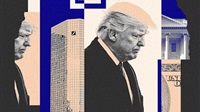
The Deutsche Bank Trump tax leak has emerged as a previously undisclosed banking privacy incident, with leaked internal documents revealing that the German lender accidentally shared President Donald Trump's tax statements and financial information belonging to more than 1,500 private banking accounts in March 2017.
According to an investigation by the Financial Times, senior Deutsche Bank executives, including current chief executive Christian Sewing, were aware of the incident as the bank considered ways to avoid notifying affected clients.
The revelations raise questions about financial data protection, regulatory disclosure requirements, and the bank's handling of sensitive customer information during Trump's first presidential term.
Deutsche Bank Accidentally Exposed 1,586 Client Accounts
The Deutsche Bank Trump tax leak occurred on March 30, 2017, when a relationship manager inadvertently transmitted year-end tax statements covering 1,586 private banking accounts to an accountant working for a single client.
The documents included sensitive financial information from Trump's accounts, along with records belonging to other wealthy customers.
The accountant recognized that the file had been sent in error, alerted Deutsche Bank, and deleted the material.
Internal correspondence indicated that the documents had been stored in a shared folder without appropriate access restrictions and were transmitted using DocuSign, a document transfer service.
Although the bank concluded that the likelihood of misuse was low, the incident exposed weaknesses in its internal handling of confidential financial records.
Christian Sewing Was Informed of the Data Breach
At the time of the incident, Christian Sewing headed Deutsche Bank's private banking division.
On March 31, 2017, managing director Frank Kuhnke informed Sewing about the accidental disclosure, explaining that the transmitted documents included approximately 1,500 pages of tax forms and account information.
The email also identified three accounts associated with Trump among the affected records.
Kuhnke described concerns about potential notification requirements under US state laws governing personal data breaches.
Internal communications reviewed by the Financial Times indicate that executives discussed strategies for limiting disclosure to affected account holders.
In a separate message, Kuhnke characterized the incident as a serious problem that might attract limited outside attention.
The correspondence suggests that managing reputational consequences became an important part of the bank's response.
Internal Emails Reveal Efforts to Avoid Client Notification
The Deutsche Bank Trump tax leak prompted internal discussions over whether customers needed to be formally notified.
According to the leaked records, Kuhnke encouraged colleagues to establish that the incident did not constitute a reportable data security breach.
He also sought to limit further external disclosure, particularly to affected account holders.
On April 4, Kuhnke informed Sewing that the incident would be classified internally as a "digital unit release" rather than a personal data breach.
The unusual terminology does not appear elsewhere in the documents examined by investigators.
Two days later, Sewing informed Kuhnke that senior executives had been briefed on the conclusion that the incident was a regulatory near-miss rather than a formal violation.
A limited internal investigation was initially planned.
However, the bank's approach did not eliminate regulatory scrutiny.
New York Federal Reserve Was Notified
Despite withholding direct notification from affected customers, Deutsche Bank informed the Federal Reserve Bank of New York about the accidental disclosure.
The regulator raised questions about the potential impact on politically prominent clients and whether customers should receive notification.
Deutsche Bank justified its position by arguing that the risk of financial information being misused was minimal.
The bank cited the recipient's prompt reporting of the error and deletion of the file as reasons for concluding that customer notification was unnecessary.
A meeting between the bank and regulators took place on April 7, 2017.
Following the discussion, Kuhnke told Sewing that the meeting had largely proceeded as expected, although the Federal Reserve requested an internal investigation.
Sewing responded positively to the update while acknowledging the seriousness of the original mistake.
The available correspondence does not establish that regulators formally determined the bank had violated customer notification laws.
Trump's Longstanding Financial Relationship With Deutsche Bank
The incident occurred against the backdrop of a decades-long financial relationship between Trump and Deutsche Bank.
The bank began lending to Trump in 1998 and eventually became one of his most important financial backers.
It continued extending credit despite his history of loan defaults and a 2008 legal dispute in which Trump sued the bank over a defaulted loan.
Deutsche Bank maintained its relationship with Trump through his first presidential term.
By 2021, when the lender stopped pursuing new business with him, Trump still owed the institution more than $300 million.
The bank's exposure to Trump's finances made the accidental disclosure particularly sensitive during a period of intense public scrutiny over his refusal to release his tax returns.
Unlike most recent American presidents, Trump declined to voluntarily publish his complete tax records.
Tax Disclosure Controversies Add Political Significance
The Deutsche Bank Trump tax leak is separate from another controversy involving Trump's financial records.
During his first presidential term, an Internal Revenue Service contractor disclosed Trump's tax information without authorization.
In 2026, Trump filed a lawsuit seeking at least $10 billion from the US government over that disclosure.
According to the supplied Financial Times investigation, the case subsequently led to a favorable settlement for Trump while he was serving as president.
The newly revealed Deutsche Bank incident is significant because it involved a separate disclosure of sensitive financial documents by a private financial institution.
The investigation does not indicate that the accountant who received the documents publicly released Trump's tax information or used it improperly.
International Investigation Exposes Banking Privacy Concerns
The findings emerged from a major international investigation into millions of leaked Deutsche Bank records.
More than 200 journalists from numerous media organizations, including the Financial Times, Der Spiegel, Le Monde, and The New York Times, participated in examining the material.
The project was coordinated by Barracuda Media, a South African nonprofit organization, with technical assistance from Germany's Data and Research Center.
The documents were obtained by Indian journalist Josy Joseph and South African investigative journalist Khadija Sharife.
The records provide insight into how Deutsche Bank executives responded to potential regulatory and reputational risks following the accidental disclosure.
They also raise broader questions about whether financial institutions consistently prioritize customer transparency when sensitive information is exposed.
Deutsche Bank Declines to Discuss Individual Client Records
Responding to questions from the Financial Times, Deutsche Bank declined to comment on specific customer relationships.
A spokesperson said the bank generally could not discuss confidential interactions with US supervisory authorities or matters involving suspicious activity reporting.
Kuhnke did not respond to a request for comment, while the Federal Reserve Bank of New York also declined to comment.
The accountant who received the documents said he did not remember the incident.
The available reporting therefore leaves some questions unresolved, including whether affected customers were ever informed through other channels or whether additional internal corrective measures followed.
Deutsche Bank Trump Tax Leak Raises Accountability Questions
The Deutsche Bank Trump tax leak highlights the challenges financial institutions face when confidential customer information is accidentally disclosed.
Although the bank reported the incident to a major regulator and cited limited risk of misuse, internal communications indicate that executives also sought to avoid notifying affected clients.
The case raises questions about how financial institutions classify data security incidents, apply notification requirements, and balance reputational interests against customer privacy.
It also illustrates the sensitivity of financial information involving politically prominent individuals.
The investigation does not establish that the disclosure resulted in fraud, public dissemination of the documents, or a confirmed regulatory violation.
Nevertheless, the previously undisclosed incident adds to scrutiny of Deutsche Bank's internal controls and its handling of confidential financial records involving high-profile clients.