At five in the afternoon, Cairo time (29).. America and the Muslim Brotherhood (2)
Iran Is the Core of the Dispute!
Before moving forward in our
study of the history and trajectories of the relationship between “America and
the Muslim Brotherhood,” we must first answer two important questions that have
been the focus of communications and inquiries from many friends and followers
since yesterday:
The first question concerns
America’s strategic position toward the international Muslim Brotherhood
organization: Will Washington proceed with banning and designating the
remaining branches of the organization as terrorist entities, or will it limit
itself to the branches in Egypt, Jordan, and Lebanon?
The second question, closely
related to the first, revolves around the main reasons that led the United
States—and its president, Donald Trump, in particular—to designate only those
three branches, at this very moment (on the eve of a potential U.S. strike
against Iran), as terrorist organizations.
We begin directly with the answer
to the first question, and in one word: Trump’s decision last Tuesday, January
13, is merely part of a plan to tame the organization, which has branches in
more than 84 countries, including the United States itself. America needs all
of them in its upcoming moves on the international chessboard, as pawns that
can be deployed and played. This is followed by a phase of repositioning in
line with the new phase and Trump’s plan, especially in the Middle East.
As for the answer to the second
question—why those three branches in particular?—it is linked to what we
observed in our response to the first question. Anyone following what occurred
during the twelve-day war between the United States and Israel on one side and
Iran on the other, as well as the statements by Trump and Netanyahu about
changing the maps of the Middle East and cutting off Iran’s arms in the region,
must also note the positions of the international Muslim Brotherhood
organization—especially those three branches that are fully allied with Iran—at
a time when they maintain close, longstanding, and deep interests and relations
with the United States.
Thus, a pause with these branches
was inevitable, particularly as they fall within what is known as the “ring
states” or “frontline states” (those that share direct borders with Israel),
especially since three of them support Iran and are considered by some to be
among its regional arms—excluding Syria. There, the organization issued a
statement on June 19, following a letter sent on June 16 by Salah Abdel Haq,
leader of the Egyptian Muslim Brotherhood organization (London Front), to
Iran’s Supreme Leader Ali Khamenei, in which he announced the organization’s
support for Iran and placed all its capabilities at Tehran’s disposal in that
confrontation with Israel.
The Syrian Muslim Brotherhood’s
statement attacked Salah Abdel Haq’s letter, describing it as a message of
support for killers who had wallowed in the blood of Syrians for a decade—an
allusion to Iran’s support for Bashar al-Assad and his regime in its war
against the opposition.
The same occurred with the
organization’s branches in Jordan and Lebanon, when both supported Iran against
Israel and placed all their capabilities and personnel at its disposal in the
region. This prompted the government of King Abdullah in Jordan to ban the
organization and designate it as terrorist in the Kingdom on April 23,
2025—more than eight months before Trump’s decision was issued.
It is important here to note that
the Mahmoud Hussein wing (Turkey Front) was well aware that the Egyptian branch
would pay a heavy price for publicly declaring its alliance with and support
for Iran. Accordingly, on the same day that Salah Abdel Haq, leader of the
London Front, issued his statement, they came out to affirm that they had
issued no statements supporting the Iranian side, that they opposed the
statement that had been released, and that they called on the press and media
outlets to exercise accuracy and attribute statements to their rightful authors
without generalization.
Before proceeding to chart the
history and trajectories of the relationship between America and the Muslim
Brotherhood, and how it has been leveraged in Washington’s favor throughout,
let us take a look at the history of the relationship between Iran and the
Muslim Brotherhood, given the clear intertwining of these two relationships on
the stage of current and potential events.
Iran and the Muslim Brotherhood
The relationship between the
international Muslim Brotherhood organization—especially the Egyptian Muslim
Brotherhood—and Iran is an old one, dating back to the organization’s founding
by Hassan al-Banna. It goes back to 1938, when Ruhollah Mostafa Mousavi (later
Imam Khomeini, leader of the Iranian Revolution in 1979) visited the
headquarters of the Muslim Brotherhood and held a private meeting with the
organization’s then General Guide, Hassan al-Banna. That meeting remained the
foundation of the relationship between the group and the ayatollahs, especially
after Khomeini later carried out his revolution and seized power in Iran.
When Al-Azhar Al-Sharif adopted a
policy of rapprochement among Islamic schools of thought in the 1940s, the
Iranian cleric Mohammad Taqi Qomi visited Egypt and met Hassan al-Banna,
founder of the Muslim Brotherhood. Likewise, Navvab Safavi, founder of the
revolutionary Shiite movement Fada’iyan-e Islam, opposed to the Shah’s rule at
the time, visited Egypt at the invitation of the Muslim Brotherhood.
The Muslim Brotherhood did not
merely welcome the emergence of the Islamic Republic in Iran in the aftermath
of Khomeini’s 1979 revolution; rather, a delegation from the group led by
Youssef Nada traveled by private plane—the third aircraft to land in Tehran—to
congratulate Imam Khomeini and place the organization’s capabilities at his
disposal.
Iran reciprocated this stance
when it enthusiastically celebrated the Muslim Brotherhood’s rise to power in
Egypt. Ali Khamenei delivered a famous sermon on the Friday of Mubarak’s
resignation, congratulating the Brotherhood on their revolution and affirming
that the capabilities of the Islamic Republic of Iran were at the
organization’s disposal.
This relationship extended to
include the Islamic Group in Lebanon (the Muslim Brotherhood’s branch there).
The last statement by the group’s former secretary-general, Fathi Yakan,
affirmed that “the schools of Islamic awakening are confined to three schools:
the school of Hassan al-Banna, the school of Sayyid Qutb, and the school of
Imam Khomeini.”
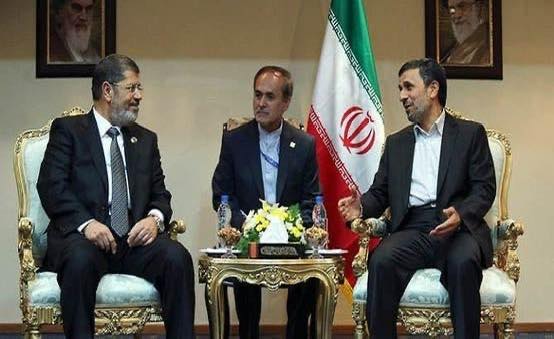
In February 2013, the deposed
president Mohamed Morsi hosted his Iranian counterpart Mahmoud Ahmadinejad
during an Islamic summit he convened in Cairo, following protests that swept
the country against his rule. At the time, Ahmadinejad delivered a speech at
Al-Azhar Al-Sharif, expressing the depth of relations between the two sides and
implicitly considering Egypt to have become Iran’s gateway to the region.
Ahmadinejad’s visit to Cairo was
not the only one by prominent Iranian figures. During that period (the period
of Brotherhood rule), several Iranian intelligence and military figures visited
Egypt—most notably the visit by General Qassem Soleimani, commander of the
Revolutionary Guard, who was assassinated by the United States in Iraq in
2016—following Morsi’s secret request for Iran’s assistance in establishing a
Revolutionary Guard composed of Brotherhood elements in Egypt, to strengthen
the group’s grip on power.
A Suspicious Alliance
In recent years, relations have
deepened between Tehran and the youth group known as the “Change Front,”
founded after the June 30 revolution by the leader Mohamed Kamal, founder of
the armed wing of the Muslim Brotherhood and its special committees, who was
killed in a confrontation with the Egyptian police in October 2016. After
several cadres assumed leadership of this group, leadership has now passed to
Yehia Moussa (sentenced to death in the assassination of Egyptian Public
Prosecutor Counselor Hisham Barakat) and Mohamed Montasser. They are currently
forming special cells and clandestine cluster groups resembling the movements
“Hasm,” “Liwa al-Thawra,” and “Kataeb Helwan.” This group maintains close ties
with Iran, and its funding is overseen directly by the Revolutionary Guard.
Most recently, these groups
joined a suspicious alliance involving the Technocrats of Egypt organization
and the Muslim Brotherhood (Salah Abdel Haq wing). They communicate with what
is known as “Generation Z,” including those youths who closed Egyptian embassies
abroad, to outline the features of a plan they dubbed the “Joints Revolution.”
They also oversee fabricated referendums in the virtual reality of the
internet, aimed at stripping legitimacy from the June 30 regime.
This is in addition to planning
organized smear campaigns against Egyptian national institutions (the army,
police, and judiciary), in an attempt to create a state of chaos in Egypt
resembling what occurred in January 2011, to enable the Muslim Brotherhood to
return to power.
We continue in the coming
installments… the course and trajectories of the relationship between the
Muslim Brotherhood and America.
Paris: 5:00 p.m. Cairo time.