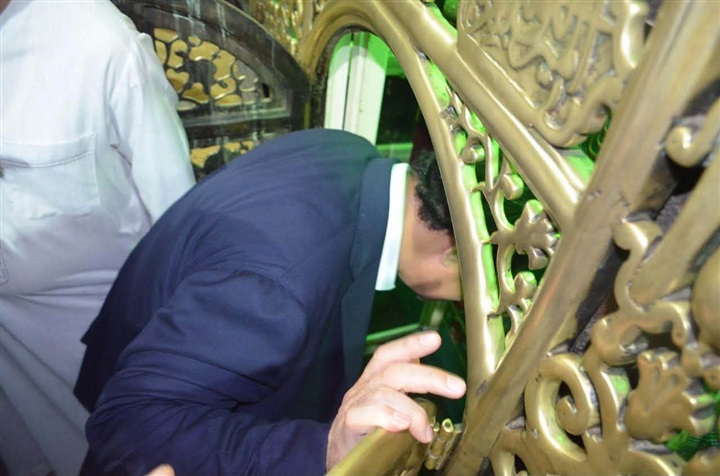
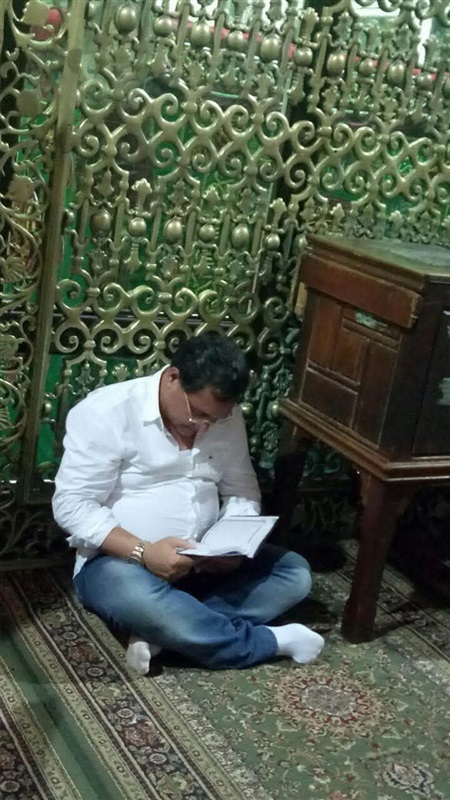
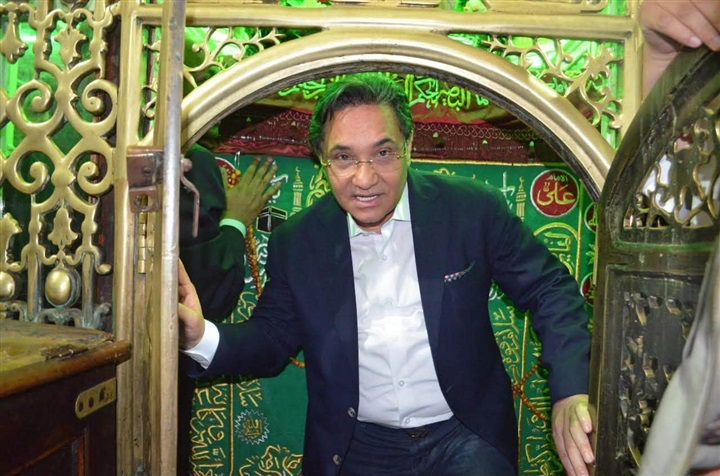
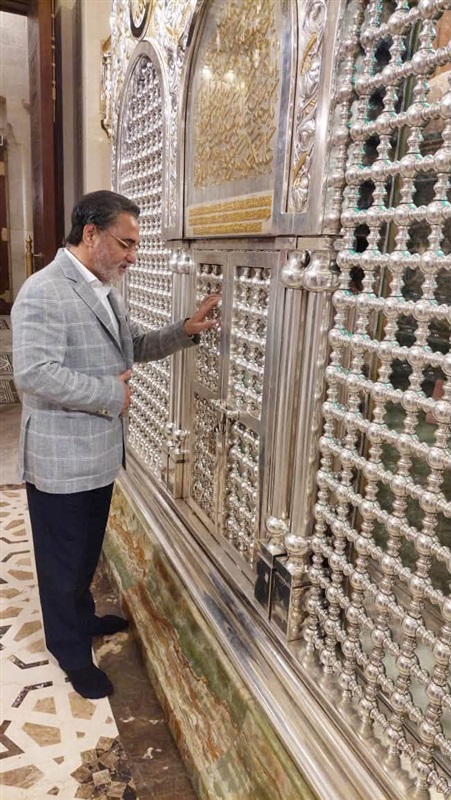
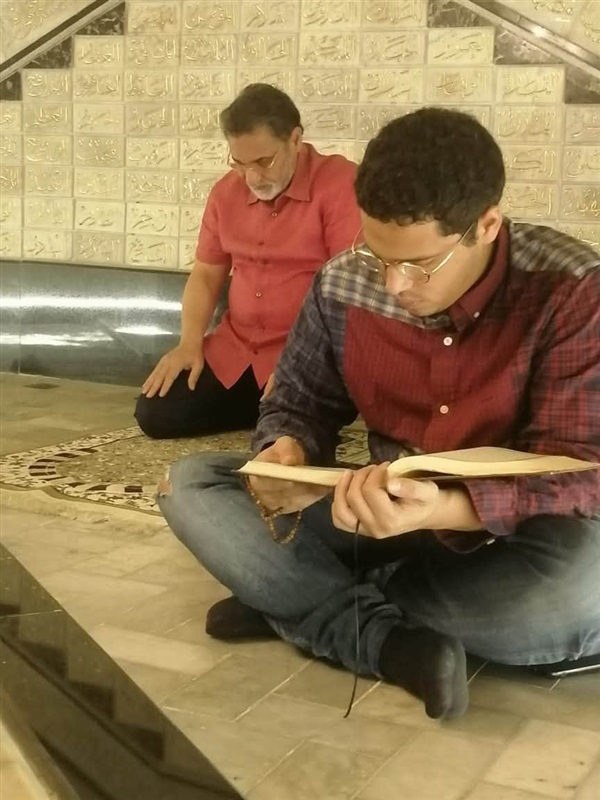
I am a lover in the presence of my Master. Before such overwhelming beauty, I nearly melt away. I do not leave my seat, nor my station, before the Throne of Love, so long as life still grants room for another meeting.
My father—may God have mercy upon him—traveled the earth from east to west in search of nearness to the beloved ones: the Family of the Prophet and the righteous followers. His heart was devoted to my Master, Abu al-Hasan al-Shadhili. From there, his gaze stretched toward the shrines of the noble masters: Ibrahim al-Desouki and Ahmad al-Badawi, together with the honorable descendants of the Prophet's Household, especially my Master al-Husayn, my Lady Zaynab, and Lady Nafisa, the Jewel of Knowledge.
From him I inherited the love of wandering. I traversed the earth in search of love until I found it in their sanctuary. Early in life I was captivated by the story of al-Hallaj and the poetry of Ibn Arabi. I found myself whispering in the grand avenues of Paris:
I wander, yearning for the sight of Him—how may union come?
Will He, I wonder, accept one so burdened with faults?
Presumptuous am I in claiming love for Him,
Yet love itself arrives, leading the one whom it seeks.
In Milan—the capital of fashion—I cry out for divine assistance, and suddenly the voices of the great chanters reach me from the heart of my distant hometown in Upper Egypt, Minya, where Sheikh al-Tuhami and the giants of devotional praise still echo:
"Have mercy upon me, for I am utterly enraptured."
I lose myself upon the roads of love, seeing no one but them. And I often laugh quietly to myself whenever I witness people attaching strange labels to those intoxicated by divine love, while standing spellbound before those equally consumed by other passions—women, countries, music, cinema, art, and song. These very arts, which genuinely nourish the soul, inspire them to write novels and stories, to compose verses celebrating Majnun Layla. Yet the moment divine love is mentioned, they strike discordant notes about those who are consumed by it.
My Father's Legacy
The earth became a prayer rug, and the roads became litanies. My father left me no property, nor did he record any wealth in ledgers.
He left me only one address: that love must be sought among those who truly possess it, and that the earth itself is merely a passage leading to their thresholds.
I was still a child when I understood that his journeys were never tourism. A man who crossed countries merely to sit for an hour beside a shrine, then returned in silence without recounting what he had seen, was not searching for a place; he was searching for a spiritual state that existed nowhere else.
I inherited his path not because he taught it to me, but because I saw his face whenever he returned, and wished that one day my own face might resemble his. The path is never inherited through words; it is inherited through witnessing.
From that day onward, the whole earth became for me a single folded prayer rug. I travel, finding my daily litany in airports just as I find it in Sufi lodges. I carry Minya within my breast to Venice, until that foreign city begins speaking in my own tongue rather than its own.
This is not homesickness for a country.
It is the discovery that the heart itself never emigrates.
The tourist searches for a new place.
The traveler upon the spiritual path searches everywhere for his ancient self.
Al-Hallaj and Ibn Arabi
To al-Hallaj I owe courage.
To Ibn Arabi I owe expansiveness.
Al-Hallaj taught me that words have a price, and that whoever speaks what cannot be spoken must carry his own cross upon his shoulder without hesitation.
What fascinated me in his life was not its final scene as much as everything that preceded it: a man incapable of concealment. Concealment is a discipline; the inability to conceal is a spiritual state. Between the two, men are truly tested.
Ibn Arabi taught me that ecstasy without knowledge becomes delirium, and that knowledge without spiritual taste becomes nothing more than bookkeeping.
He opened before me an ocean called Meaning.
He taught me that existence itself is a book; that language is narrow while allusion is vast; that whoever reads only the letters without reading the ink itself remains standing upon the shore, counting grains of sand.
To me, Sufism that is merely read but never tasted is only culture.
Sufism that is tasted but never disciplined is mere pretension.
Between the two lies the path—a path with its own balance: sincerity, purity of intention, companionship, and proper conduct.
Whoever attempts to fly without wings will fall.
Whoever imagines that love exempts one from religious obligation has wronged love long before wronging obligation.
The Thresholds of the Prophet's Household
Cairo is not merely a city upon a map.
Cairo is a series of sacred thresholds.
At the shrine of my Master al-Husayn, I learned that love is astance, and that blood shed for principle becomes an ink that never dries.
I do not visit him merely to ask.
I visit to remember that truth demands a price, and that the Prophet's Household paid it with honor.
At the shrine of my Lady Zaynab, I learned that patience is not silence. The woman who carried unspeakable tragedy and then stood before the tyrant, speaking fearlessly in his own court, embodied the truest meaning of courage when stripped of every weapon. Her cry before Yazid—
"Silence, O son of the freed captives!"
became a title borne forever by history.
At Lady Nafisa's shrine, I discovered that knowledge constitutes another lineage. She was a scholar from the Prophet's Household before whom great imams themselves sat as students. Thus her home became a school, and her resting place became a gateway.
At the shrine of my Master Abu al-Hasan al-Shadhili in Humaythara, of al-Badawi in Tanta, and of al-Desouki in Desouk, I witnessed what books cannot show.
The simple people who travel long distances to attend the religious festivals are not ignorant.
Rather, they instinctively know that love requires the body as well as the soul, and that a heart that never walks can never truly arrive.
For me, love for the Prophet's Household is neither a doctrine with which I quarrel against others nor a slogan by which I claim superiority.
It is simply the natural continuation of my love for the Messenger of God, peace and blessings be upon him and upon his family.
Whoever loves the root loves the branches.
Whoever loves the Light loves everything illuminated by it.
In Defense of the Ecstatics
How astonishing people are!
They admire a man driven mad by a woman, calling him a poet. They turn his letters into books, and his sleepless nights into songs sung by millions.
They admire one consumed by love of his homeland, calling him a hero, raising his portraits in public squares.
They admire another who became obsessed with melody until he lost both hearing and reason, calling him a genius, while audiences sit silently in theaters honoring his life.
They admire the artist who cut off his own ear for the sake of a painting, then pay the price of an entire city for one of his canvases.
Yet when a man is consumed by God and for God, they dismiss him as a majdhūb—an ecstatic.
They utter the word with either pity, suspicion, or ridicule.
I do not ask such people to understand.
I ask only that they be fair.
If madness inspired by beauty is considered a virtue when beauty is imperfect, how can it become a vice when Beauty itself is absolute?
If annihilation in the beloved is praised when the beloved is merely human, how can it become superstition when the Beloved is the Lord of humankind?
Yet, in fairness to the truth—and without concealment—I must admit that smoke has entered the field.
There are those who wear the Sufi cloak merely to eat and drink from it; those who claim spiritual states in order to escape accountability; those who transform religious festivals into marketplaces and followers into livelihoods.
Such people damage the path more than its enemies.
The enemy attacks from without.
These hollow it from within.
But the criterion already exists.
It was not established by the critics of the path.
It was established by the masters of the path themselves:
Every spiritual reality that is not confirmed by the Sacred Law is heresy.
Whoever disciplines himself by this standard belongs among us.
Whoever abandons it must bear his own burden alone, not place it upon the shoulders of the saints.
The existence of counterfeit does not invalidate the genuine.
No one abolished medicine because charlatans exist.
No one prohibited poetry because poor poetry exists.
Why, then, is divine love alone judged by its worst claimants?
I did not choose this path as one who weighs schools of thought, studies them, and then decides.
The path chose me.
I was still a child, watching my father's face as he returned from journeys I could not understand. I saw in his face something I had never seen in anyone else's:
A man who had seen enough to be forever satisfied.
Then I grew up.
I traveled the earth as he had traveled it.
I stood in the streets people dream of visiting, yet I found nothing in Paris that I had not already found upon the threshold of a saint's shrine.
Rome gave me nothing greater than a single verse of devotional praise whose author I never even knew.
This is no claim to sainthood.
Nor is it a claim to spiritual rank.
I am simply a man who loves.
It is enough for me that I learned, while still young, whom to love, and therefore did not waste my life in endless experimentation.
If you ask me, "Until when?"
I shall answer:
I am a lover in the presence of my Master. I shall never leave my seat nor my station before the Throne of Love, so long as life still leaves room for one more meeting.