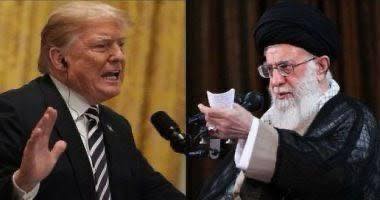
At five in the afternoon, Cairo time (32).. Khamenei..A Supreme Guide in the Eye of the Storm (1–2)
Today and tomorrow only, we are
pausing the publication of the series of articles (America and the Muslim
Brotherhood) due to the intensity of developments on the Iranian scene.
Yesterday, Saturday, U.S. President Donald Trump called for ending the rule of
Iran’s Supreme Leader Ali Khamenei, which has lasted more than (37) years,
saying, “It is time to look for new leadership in Iran,” according to the
website Politico.
Dan Shapiro, former U.S.
ambassador to Israel and coordinator of the Abraham Accords, commented on
Trump’s remarks in a post on the platform X, saying:
Donald Trump’s description of
Khamenei as “irrational,” and his talk about the need for a new leader for
Iran, lead him to believe that Trump intends to kill Khamenei this week.
Trump’s statements and Shapiro’s
comment came shortly after Khamenei’s account published a series of messages
addressed to Trump, accusing the U.S. president of being responsible for deadly
violence and unrest in Iran.
The statements issued by the
Supreme Leader of the Iranian Revolution over the past two weeks—whether
through Friday sermons or via his online account—carried a number of internal
and external messages. Against the backdrop of widening protests across the
country, he attacked U.S. President Donald Trump and described the protesters
as “mercenaries” working for foreigners.
He affirmed that unifying ranks
within the country is the path to ensuring victory over enemies and
safeguarding Iran’s independence and sovereignty.
While this discourse proved
effective during the twelve-day war with Israel, when it produced popular
cohesion and unity behind the state, the scene today has changed dramatically
with the expansion of domestic popular protests and the rising ceiling of U.S.
and Israeli threats—developments that directly threaten the country’s national
security and undermine its unity and sovereignty.
Beginnings
Who, then, is the man leading
Iran at this critical juncture in its history, and what has he done throughout
his tenure—actions that have driven the country toward a strategic
transformation that may topple the image of Iran we have known since the Iranian
Revolution of (1979) in favor of another image whose features are being shaped
in European and American capitals, as well as in the mind of the Iranian
citizen who has been marginalized for decades in favor of the dreams and
ambitions of the ayatollahs?
After the success of the Iranian
Revolution in (1979), Ali Khamenei, the current Supreme Leader of the
Revolution, was elected a member of the first term of the Islamic Consultative
Assembly, the first parliament in the era of the Revolution. He has remained
part of the political system ever since. He co-founded the Islamic Republican
Party with Ayatollah Mohammad Beheshti, Ali Akbar Hashemi Rafsanjani, and
Ayatollah Mousavi Ardebili.
From his post as Deputy Minister
of Defense in (1979), to Chairman of the Expediency Discernment Council and
Supreme Leader of the Iranian Revolution in (1989), Khamenei became known for
maneuvering and intrigue. He reached the latter post after a constitutional
amendment that allowed a mujtahid to assume the position of Supreme Leader,
which had previously been reserved exclusively for a faqih. This subject has a
long story tracing back to Ayatollah Khomeini’s fatwa on “Guardianship of the
Jurist,” which we may devote space to later this week.
The Supreme Leader of the
Revolution in Iran is the ultimate authority and foundation for shaping foreign
policy, wielding immense spiritual and coercive power within the state.
Unfortunately, Khamenei’s policy began with a clear hostility toward Arabs and
a pathological attachment to the illusions and dreams of the Persian Empire.
Accordingly, Iran has been strongly present in numerous regional files: in
Lebanon through Hezbollah, which has waged—and continues to wage—proxy wars on
behalf of Tehran, whether against Israel or within Lebanon itself.
In Iraq, through the Dawa Party
led by Nouri al-Maliki, which played the greatest role in tearing apart Iraq’s
political, sectarian, and ethnic fabric. In Palestine, through exploiting the
financial needs of Islamic resistance movements—whether Hamas or Islamic
Jihad—to carry out operations that serve the Iranian Supreme Leader Khamenei’s
objectives before serving the goals of the Palestinian people. Chief among
these was the October 7 operation, which was carried out on his personal
instructions after a meeting he held with Hamas leaders on June 14, (2023),
four months before the operation’s execution.
Tehran also exploited Hamas in
repeated efforts to split Palestinian ranks—efforts that ultimately succeeded
in fragmenting the Palestinian state into two halves led by two governments: a
legitimate government headed by the elected president Mahmoud Abbas, and a
secessionist government led by Hamas—prior to the latest destruction after
October (2023).
Finally, in “Happy Yemen,” which,
thanks to direct Iranian intervention through the Houthi group, has been
transformed into “Unhappy Yemen.”
Persian ambitions exceeded the
bounds of the alleged Shiite Crescent and expanded to reach control over parts
of the northern summer and southern winter Silk Roads, which pass through the
Middle East region and the coasts of Africa.
It is known that the northern
Silk Road passes from Mosul in Iraq to Aleppo in Syria; thus, it was not
surprising that wars ignited in those areas. Direct supervision was entrusted
to General Qassem Soleimani, the former head of Iran’s Revolutionary Guard,
before his assassination in Baghdad by the United States in January (2020).
While the emergence of ISIS
helped intensify Iranian presence in both Mosul and Aleppo prior to the fall of
the Assad regime, many accusations have been—and remain—directed at Iran for
manufacturing this suspicious organization.
The announcement by several
countries over the past decade—including Egypt, Saudi Arabia, Morocco, Bahrain,
Kuwait, Yemen, and the United Arab Emirates—that they uncovered espionage cells
working for Iran is further evidence of its intention to expand its influence.
Especially since Iranian leaders, who have moved from concealment to openness
in their statements, do not hesitate to declare that Sana’a has become the
fourth Arab capital to fall under their dominance after Beirut, Damascus
(before the fall of the Assad regime), and Baghdad—although it is, in reality,
the fifth Arab capital when counting Arab Ahvaz, which the mullahs’ regime
swallowed, subjugated its people, and annexed to the Iranian Republic after the
Revolution.
The Arabian Gulf
After occupying the entire
eastern coastline of the Arabian Gulf—where the Emirati islands and some Omani
islands are located, especially those situated at the Strait of Bab al-Salam
(Hormuz)—Iran took control of the most important maritime passages of the Silk
Road. It occupied the Yemeni port of Assab overlooking the Red Sea and leased
the Eritrean islands of Fatima and Nahlika to expand its influence in the Bab
al-Mandeb Strait.
Although the Silk Road began with
the trade in silk some (3,000) years before Christ, the Persian state seeks
dominance over its most important corridors to control trade—especially the
drug trade for which it has become notorious—and to spread the “Safavid”
sectarian doctrine based on fomenting discord.
While states have the right to
pursue their interests, this does not negate the fact that all past empires in
history have vanished forever, including the British Empire “on which the sun
never sets.” Yet the Persian regime remains the only one aspiring to revive the
empire of the Khosrows and the Sassanids. The source of these aspirations is
delusions of power. A state incapable of feeding its people is far less able to
stretch its legs beyond its blanket—something that does not apply to Iran,
whose economy has entered a state of near-total collapse and depends by more
than (60)% on smuggling.
America, Tehran, and Iraq
The ongoing conflict in the
region between America and Iran has not always taken the form of confrontation;
at times it assumed the shape of an alliance, as occurred in Iraq during the
U.S. invasion of Baghdad in (2003).
Khamenei held several rounds of
talks before and during the invasion of Iraq—at least three of them during
(2003) (in January, March, and May)—to discuss the situation in Iraq. Although
a United Nations representative opened these talks to preserve their status as
indirect negotiations, the UN representative would always withdraw, leaving the
American and Iranian delegations to conduct direct bilateral talks.
While “Franco” announced his
victory by means of a fifth column during the Spanish Civil War, the Americans
have kept, to this day, the great secret that they did not occupy Baghdad at
such record speed except because of the Iranian fifth column—which welcomed the
American occupying forces in Baghdad as a symbolic expression of this
Iranian–American alliance.
America’s wager in its war
against Saddam and its occupation of Iraq in (2003) was never on minor agents;
rather, it was a direct wager on the Iranian role—and Iran’s agents. Contacts
between these agents and Washington intensified before the war in preparation
for the occupation of Iraq.
At the very moment the first
American missile was launched at Baghdad, Iraqi armed groups loyal to Iran
began entering the country from all directions, led by Iranian military
officers and advisers. There was full coordination between Washington and Tehran,
which placed its intelligence apparatus entirely at the Americans’ disposal
through its agents. Thus, American forces did not advance into Baghdad until
the Iranians—through their proxies Mohammad Baqir al-Hakim, Abdul Aziz
al-Hakim, Nouri al-Maliki, al-Anzi, Izz al-Din Salim, Majid al-Khoei, and
others—had taken control of Baghdad; the principal credit belonged to them.
After the battle ended and the
occupation stabilized in Baghdad, the price began to be paid. The Americans did
not hand power to the agents they had groomed for years—such as Ahmed Chalabi
and the Iraqi National Accord, the Islamic Party, and the Communist Party—but
instead delivered it to Iran’s proxies and men who had allied with them in the
war and facilitated their entry into Baghdad. Thus, the al-Hakim family became
the first absolute ruler in Iraq, albeit confined at the time to the Green Zone
prison in central Baghdad.
According to the language of
interests, the destruction of Baghdad was an American “strategic” gift to the
Iranians. Iraq had constituted a historical obstacle to their westward Arab
advance—the only expansionary sphere available to the Iranians to play a
regional role—especially since the sectarian card is the only card they have on
the table.
Tomorrow, we will explain
Khamenei’s specific role in Iraq, and in many other files whose threads
intersected between Tehran and Washington—such as Afghanistan, Lebanon, and
Palestine. Until tomorrow.
Paris: 5:00 p.m. Cairo time.