At five in the afternoon, Cairo time (36).. France’s Decision Against the Muslim Brotherhood: The Beginning of a New European Phase to Dismantle the Organization (1)
I could not continue publishing
the series of articles “The Muslim Brotherhood and America” without briefly
pausing to address the decision of the French Parliament yesterday to declare
the Muslim Brotherhood a terrorist organization, after years of study and
public debate inside and outside parliament, in the corridors of political
parties, on the pages of major newspapers, and on the screens of leading French
television channels.
The Republican Right bloc
submitted the proposal, calling for legal recognition by the European Union of
the political nature of the separatist ideology adopted by the group and for
its classification as terrorism.
After the project was examined by
the Committees on European Affairs and Foreign Affairs in the French
Parliament, parliament approved the draft resolution yesterday during a plenary
session.
The law is scheduled, in its next
step, to be referred to the institutions of the European Union to discuss the
project and consider its adoption. If approved, it will be applied in all EU
member states, a development that places the Brotherhood’s project of
infiltrating and settling European societies at the mercy of the winds.
What happened yesterday was not
detached from its context. In May 2025, the Ministries of Interior and Foreign
Affairs decided to form an investigative committee into the influence of the
Muslim Brotherhood in France and the external support they receive from states
or international organizations to deepen the idea of separatism.
This investigation was entrusted
to the seasoned French diplomat François Gouyette, who previously served as
France’s ambassador to the United Arab Emirates, Libya, Tunisia, the Kingdom of
Saudi Arabia, and Algeria, as well as to a senior official in the Ministry of
the Interior, Pascal Courtade. This took place during the tenure of Bruno
Retailleau as Minister of the Interior—now the leader of the Republican Party
and one of the components of the right-wing bloc that submitted the draft law
approved yesterday.
Earlier, on August 24, 2021, the
Law on Respect for and Reinforcement of Republican Values had been issued to
rearm France against separatist ideas that the Muslim Brotherhood in France had
been advocating and implementing in practice.
Separatism, as described by the
aforementioned law, is a theoretical political Brotherhood project
characterized by repeated deviations from the principles of the Republic, with
the aim of building a counter-society.
The report issued in May 2025
indicated that the Muslim Brotherhood movement plays a major role in spreading
this ideological system that calls for separatism and in failing to entrench
and reinforce republican values.
When the report was released in
May 2025, it caused a major stir in France. We exclusively translated it into
Arabic and published it in Al-Bawaba News. It was only natural that the report
would be followed by the opening of a public debate on what should be done,
after it was established that the Brotherhood organization seeks to deepen
separatist values in French society and receives external funding aimed at
undermining the European spirit of the French Republic—until we arrived at this
point.
The Beginnings
When I set foot in France in
March 2017, seeking to establish the Middle East Studies Center in Paris as a
specialized center for studies and information on political Islam, the Muslim
Brotherhood organization was at the height of its presence. Its voice was the
loudest, and the funding provided to it by certain Arab states was in full
swing.
The battle was like a man
wielding his ancestors’ sword against people armed with the latest nuclear
weapons.
There was no parity of any kind:
dozens of Islamic centers and schools, and billions of euros at the
organization’s disposal, versus scant funding for the center. But we possessed
willpower and the right.
More than one hundred conferences
across Europe (thirty-six of them in France alone). We did not leave a single
parliamentary or political body without engaging it in a public discussion
about the organization, its ideas, its sources of funding, and its danger to
Western values and to the values of the French Republic.
Politicians, deputies, and
ministers knew nothing about the Brotherhood except that it was a democratic
organization oppressed in Arab countries and removed from power by armed force
in Egypt in June 2013.
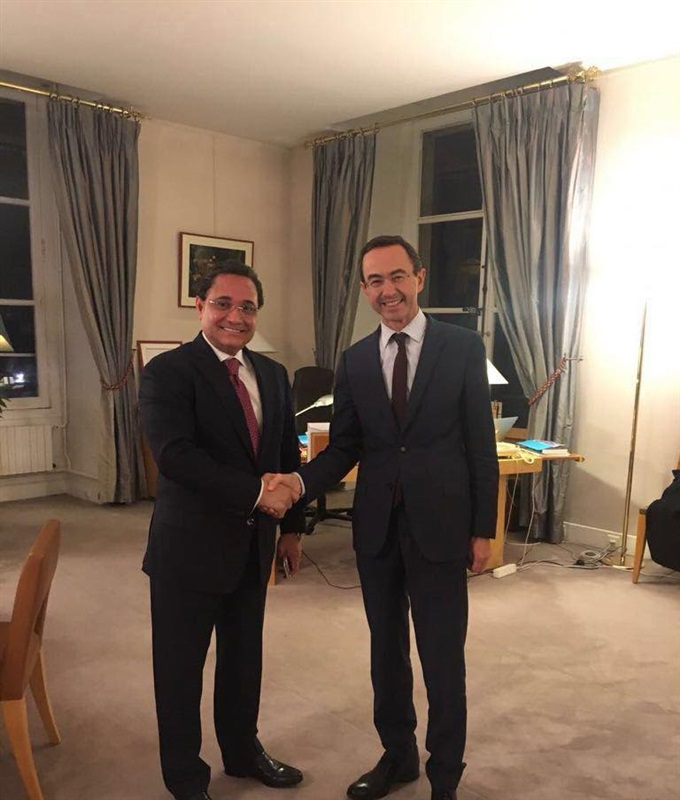
I recall that during my first
visit to the office of Bruno Retailleau—then the leader of the majority in the
Senate, head of the campaign of the Republican presidential candidate François
Fillon, later French Minister of the Interior who led this orientation, and the
leader of the Republican Party that prevailed yesterday in the parliamentary
decision to place the Brotherhood on terrorist lists—the man said to me, after
a discussion that lasted a full two hours: Why have we not heard before this
talk about the Brotherhood’s attempt to undermine the foundations of Western
societies?
He took from me several documents
containing their fatwas on issues related to women, art, democracy,
non-Muslims, and the West. I had translated them into French and titled them:
The Dangers of Brotherhood Ideology to the Values of the French Republic.
Much water has flowed under the
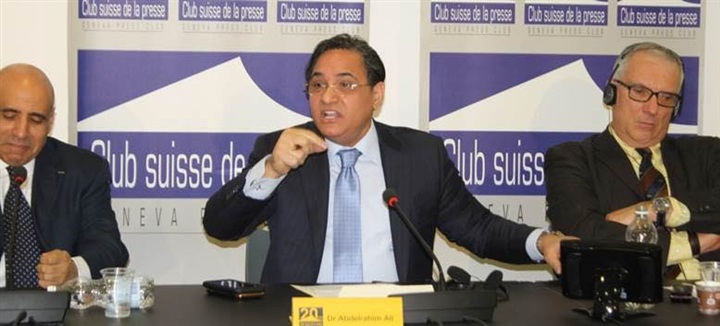
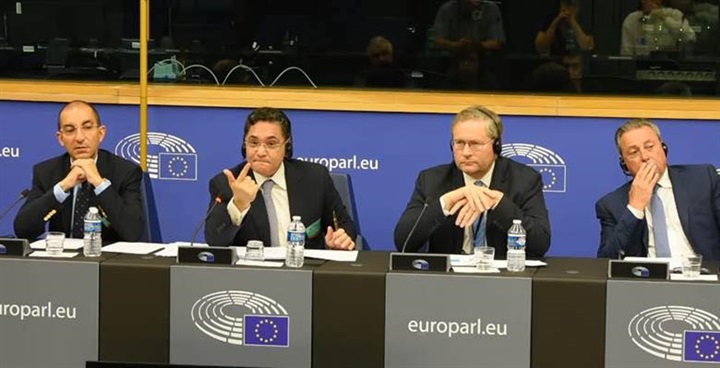
bridge since then. I publicly confronted the organization’s leaders in Geneva,
Paris, Munich, Strasbourg, Amsterdam, and Rome. I left no place unvisited,
warning of the danger of what they were planning in Europe.
When I was asked to write for the
French website Causeur, and later for Atlantico, the first article was titled:
French Islam Hijacked by the
Muslim Brotherhood
In it, I explained how the French
had, over many decades, attempted to organize what is known as “French Islam”
in a manner similar to the organization of the Jewish religion in 1804.
These attempts began in 1999 with
the creation of a federation representing Muslims in France, following a
proposal by the then French Minister of the Interior, Jean-Pierre Chevènement,
which never saw the light of day; continued with Sarkozy’s 2003 project that
established the French Council of the Muslim Faith; and culminated in French
President Emmanuel Macron’s 2020 speech, in which he declared that Islam was
undergoing a global crisis and called for reorganizing its relationship with
the state to prevent what he termed separatism.
This provoked the ire of a large
number of leaders and thinkers in the Islamic world, as well as Muslims in
France.
Those years were interspersed
with dozens of attempts that began with analyzing the phenomenon and proposing
presumed solutions from different perspectives, each according to its
intellectual position on the phenomenon.
Unfortunately, all these projects
failed because they did not address the core of the problem afflicting Islam
and Muslims in France—namely, that they are “literally” hijacked by the
international Muslim Brotherhood organization, which has recently handed over
the reins of its movement to plans, strategies, and ambitions of states from
outside the European Union.
Europe’s Tragedy
Europe’s real tragedy with
Islamism began with the advance of the third generation of Brotherhood
battalions into the European continent in the 1980s and 1990s. Until then,
Islam or Muslims had not constituted a burden or a problem within French
society or the French state.
Ordinary Muslims had been
arriving in Europe for more than a century as merchants, scholars, and
students—benefiting from and exchanging expertise, transferring it to their
home countries, or integrating into these new societies.
The real crisis began to surface
gradually with the arrival of a political Islamic group called the Muslim
Brotherhood, which believes that a Muslim must strive to establish the Islamic
state in any land where he stands or lives, and that he must operate within a
framework of secrecy and dissimulation on the path to achieving this mission.
It is a group that considered
those European countries as spoils to be converted to Islam, then gradually
seized and governed according to Islamic law, instead of repaying the kindness
of the societies that sheltered them from fear and fed them in hunger.
After large waves of flight from
countries where they were persecuted, they sought to infiltrate those societies
and betray them, believing this to be the correct religion, relying on the
principles taught to them by the group’s founder, Hassan al-Banna. In the
founder’s teachings, a Brotherhood member is commanded to implement the six
stages of the call in any country he is in—stages that begin with the
Brotherhood individual and end with the Islamic caliphate and the mastery of
the world.
The early founders of the
Brotherhood—al-Banna, al-Hudaybi, Sayyid Qutb, and Fathi Yakan—instilled these
ideas through intensive educational programs into the minds of every
sympathizer and every aspirant to the group, not to mention the active member
or organizational cadre, until these ideas became a “new Qur’an,” an
alternative to the Book of God believed in by ordinary Muslims.
In their ideological schools, the
Brotherhood learned that these six stages could be achieved through more than
one method. They begin with preaching, then recruitment to form the system of
Brotherhood families, followed by a plan to reshape society by toppling its
civil or secular pillars—whether associations, unions, professional
organizations, or student bodies—so that it becomes imbued with the concepts of
the religious state that relies on doctrinal appearances in all its formations.
Not only that, but they also
adopt brotherhood of creed as a substitute for brotherhood of الوطن, making discrimination based on religion, then on sect within
religion, and then on allegiance to the Brotherhood’s methodology over all
other groups that approach Islam in understanding life and politics.
We sensed this orientation
yesterday as we discussed the issue of secrecy and openness in the field of
preaching in the series “America and the Brotherhood,” raised by Mahdi Akef in
his report following his visit to the Brotherhood branch in America in 1991,
when he sided with the idea of secrecy as a doctrine of takeover and coup in
order to establish a different political and doctrinal system.
What, then, of the concept of
democracy and the climate of freedom of opinion and expression that those
Western countries provide?
The Brotherhood viewed this
principle as a method of selection, not as a way of life based on fundamental
pillars, including freedom of opinion and expression and freedom of belief.
According to their understanding, it became a bridge to reach power—permitting
passage only once to the other bank, after which it is destroyed—and in the
West it turned into a means of penetration and entrenchment in the joints of
those societies to destroy them from within.
Tomorrow, we continue.
Paris: five o’clock
in the evening, Cairo time.