At five in the afternoon, Cairo time (37).. France’s Decision Against the Muslim Brotherhood: The Beginning of a New European Phase to Dismantle the Organization (2)
In the previous article, we
discussed Europe’s tragedy with the international Muslim Brotherhood
organization and its attempts to take Islam and Muslims hostage in France.
Today, we continue by examining the organization’s strategy, through which it
sought to penetrate French society by multiple means—economically, socially,
intellectually, and organizationally. Unfortunately, the organization benefited
from every step taken by successive French governments to recognize it as a
representative of Islam and Muslims in France.
This occurred after the 2003
Sarkozy project, which granted representatives of the group the right to
represent Muslims in France before the French authorities, through free
selection via mosques and federations. They then began striking deals with
specific countries to finance the construction of major mosques, considering
them the gateway to leadership and representation of Muslims.
They also began forming
associations and federations that enabled them, through their representatives,
to exercise full control over the newly established council, which became the
sole legitimate representative of Muslims in France.
Former French President Sarkozy
gave the Muslim Brotherhood the legal instrument to hijack Islam and Muslims in
France in broad daylight. They restructured their organizational frameworks to
become a state within a state, capable of using their representation of Muslims
for the organization’s separatist purposes.
For all these reasons, the only
solution to dealing with this crisis—from our point of view, and as we have
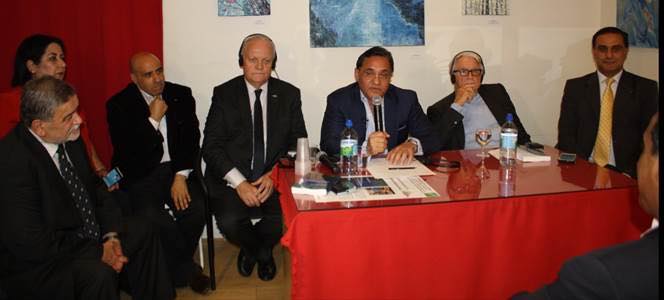
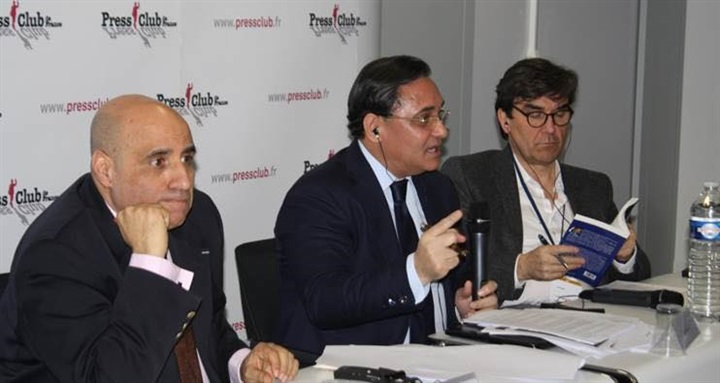
proposed in more than one conference and public discussion session in France,
whether within the National Assembly, the Senate, or even the European
Parliament in Strasbourg—is to begin confronting this Brotherhood organization
and its French branch, “The Union of Muslims of France,” by dismantling its
structure, drying up its sources of funding, and banning its associations.
None of this can be achieved
without criminalizing the organization and stripping it of legitimacy by
classifying it as a terrorist entity.
Otherwise, the French will find
themselves going in circles, returning each time to square one to start all
over again—precisely what happened in all the experiences mentioned earlier.
But how does the dismantling
process take place?
Dismantling the Muslim
Brotherhood organization that has hijacked Islam and Muslims in France is not
achieved solely by banning its structures and associations and drying up its
funding sources, but also by refuting the ideas it uses to recruit its members.
For this strategy to succeed,
those implementing it must adhere to four basic principles:
First: Avoid conflating Islam as
a religion with the organization that hijacks it, and deal with the crisis as
one of organized abduction of the Islamic religion, not as a structural crisis
inherent to Islam or Muslims.
Second: This approach must avoid
the discourse of victimhood and Islamophobia, which Brotherhood cadres,
leaders, and media mouthpieces will quickly resort to in response to such
measures.
Third: The confrontation must be
conducted on the basis of societal unity among supporters, citizens, and
politicians of the French Republic. It is neither permissible nor appropriate
for this confrontation to be undermined by any form of political infighting
among rival French political parties and currents—from the far left,
represented by the French politician Jean-Luc Mélenchon, who adopts the
Brotherhood’s victimhood narrative, to the far right, represented by Marine Le
Pen, who at times demonizes Muslims themselves. This issue is, quite simply, a
matter of national security for France first and foremost, just like the issue
of terrorism and the use of violence against peaceful citizens.
Fourth: Refrain from addressing
the issue of building “Islam in France” in the same way the Jewish model was
handled in 1806, as doing so would be akin to “using a unit of distance to
measure density.”
The Beginning of the Brotherhood
Threat
France today stands at a
crossroads after the government decided to confront the Muslim Brotherhood
decisively, and after parliament issued its long-delayed decision—at least ten
years overdue—to classify the organization as a terrorist entity. This entails
banning its activities and associations, drying up its funding sources, and
pursuing its leaders and cadres.
The international organization
arrived in France in the 1980s with a single objective that the Brotherhood at
the time termed “empowerment in the West.”
This empowerment, according to
their vision, is achieved through three stages that operate in parallel rather
than sequentially.
First: Social Empowerment
This is achieved through
establishing social institutions through which French Muslims and immigrants
are gathered and organized into structured administrative units. The process
began with seven associations in 1989, growing to 250 associations by mid-2005,
and has now reached more than 500 associations and institutions at the time of
the decision.
Second: Economic Empowerment
This takes place through direct
and indirect funding. The latter consists of diplomatic moneybags used to build
mosques, schools, cultural centers, and a number of other educational
activities. Direct funding comes through donations and bank transfers, in
addition to revenues from Islamic activities such as halal trade, Hajj and
Umrah services, and the collection of zakat and alms.
Third: Cultural Empowerment
This is achieved through
establishing cultural centers and schools, and approving and supporting private
education and homeschooling, which allowed the Brotherhood to disseminate its
intellectual and religious educational doctrine throughout these suburbs.
These three forms of empowerment
lead to political empowerment, which usually begins with influencing local and
general elections and develops into an important card that politicians must
take into account in their electoral battles—eventually reaching a stage where
the Brotherhood becomes a decisive factor in any legislative or presidential
election.
This occurred in the most recent
legislative elections in France, where the leader of the French left-wing
alliance, Jean-Luc Mélenchon, outperformed with the votes of Islamists.
Based on these conclusions,
dismantling this organization in all its social, economic, and cultural
manifestations becomes an urgent necessity, especially after its designation as
a terrorist entity by the French parliament.
Naturally, the new decision will
contribute significantly to this dismantling process, but it will not be
sufficient on its own. The Brotherhood organization is known for its ability to
adapt to all circumstances and its skill in overcoming the obstacles it has
faced throughout its history. For nearly a hundred years, the Brotherhood has
succeeded in exploiting the contradictions of its opponents to its advantage
and building its institutions through them—the Egyptian experience is the best
proof of this.
Dismantling Is a Complex Process
If France is serious about
dismantling the organization after banning it, it must first give the highest
priority to drying up funding sources, monitoring and banning them, and
prosecuting those responsible. These are the primary weapons that must be used
to initiate the next decisive step: dismantling the ideological system that the
group has succeeded in embedding within French society through its schools,
mosques, and associations.
This type of ideological
dismantling will require years of work to achieve positive and decisive
results, because France is now facing a complex process of construction,
penetration, and infiltration by the Brotherhood organization that has
continued for many years.
The Octopus
In 2009, specifically after
Egyptian security services arrested a number of Brotherhood leaders and cadres
and brought them to trial in what became known in the media as the
“International Organization Case,” Egyptian security services were able to
examine the group’s strategy of infiltration through soft power in Egypt and
around the world.
I had an appointment with the
general responsible for the Muslim Brotherhood monitoring department within
Egypt’s State Security Investigations Service, who supervised the investigation
reports related to the case. I was surprised when he abruptly asked me: Do you
believe that the members of the group’s Guidance Bureau, whose names and
capabilities we know well, are the ones who manage this octopus-like
organization on a global level?
I replied: If not them, then who,
in your view, manages this organization?
The man responded: I do not have
specific information, but based on my close knowledge of the capabilities of
these individuals, I can tell you that they are incapable of managing a
medium-sized company—let alone this enormous organization spread across nearly
half the globe.
His question and answer did not
surprise me much, because I had always been convinced that in Egypt we look at
only one face of the Muslim Brotherhood: the hierarchical organization composed
of the General Guide, the Guidance Bureau, and the Shura Council. This face of
the organization represents, so to speak, a “brand,” analogous in the political
sphere to a constitutional monarchy—where the family owns under this system,
while actual governance is in the hands of parallel political forces that hold
the majority in one way or another and rotate power in accordance with the
constitution.
I had observed and analyzed this
transformation in several of my studies, the most important of which are The
Secret Files of the Brotherhood, The Crisis of the Renewal Current, and The
Brotherhood State, among others.
From my point of view, thinking
about this transformation from a hierarchical system to a network system began
long ago, when the group was first struck in 1948 by the government of Ibrahim
Pasha Abdel Hadi, leader of the Constitutional Liberals Party in Egypt, in
retaliation for their assassination of then–Prime Minister Mahmoud Fahmy
El-Nokrashy after he decided to dissolve the group in response to its terrorist
operations inside Egypt.
Those events, which ended with
the killing of the group’s founder and General Guide Hassan al-Banna, marked
the true beginning of thinking about transitioning from the concept of a
hierarchical organization with a single, clear head—while maintaining it in a
number of countries, including the country of origin, Egypt—to the concept of a
network resembling an octopus with multiple arms.
Then came Gamal Abdel Nasser’s
crushing blow to the group in 1954, which accelerated the adoption and
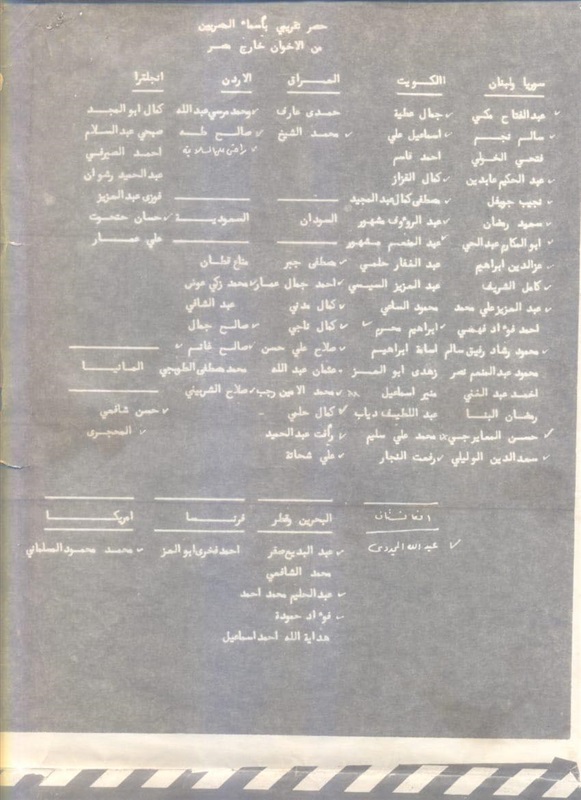
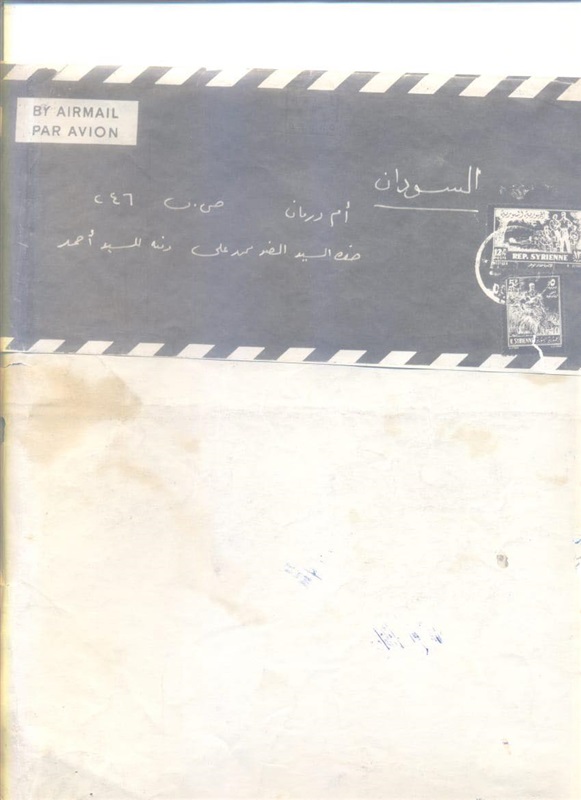
implementation of this option. We later found an old letter bearing the
postmark of Omdurman, Sudan, containing the names of the group’s temporary
leadership during the years of ordeal. All of them were unknown to the regime
or the security services in Egypt at the time; some were even considered by the
regime to be among its supporters. Strangely, all of them were living outside
Egypt. (An image of the document is attached.)
Tomorrow, we continue.
Paris: 5:00 p.m. Cairo time.