Putin Calls for Eurasian Partnership Ahead of Xi-Trump Summit in China
Wednesday 18/November/2026 - 03:35 PM
Ahmed Seif El-din
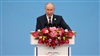
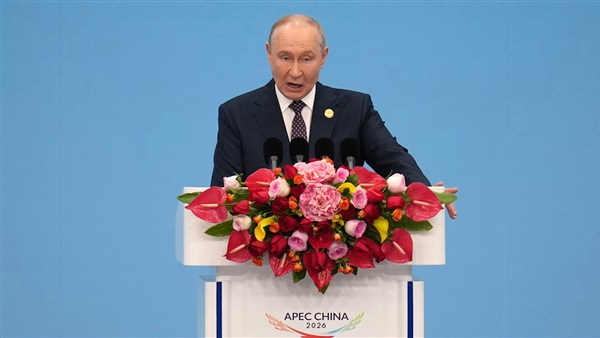
Russian President Vladimir Putin has called for a broader Eurasian partnership while criticizing Western sanctions and economic restrictions during a speech to international business leaders at the Asia-Pacific Economic Cooperation (APEC) forum in Shenzhen, China. His remarks came ahead of an anticipated meeting with Chinese President Xi Jinping and US President Donald Trump, amid mounting trade tensions and geopolitical uncertainty.
Putin Promotes Eurasian Partnership as Alternative to Western Dominance
Speaking at the APEC CEO forum on Wednesday, Putin accused Western powers of attempting to restrict the economic development of countries challenging their traditional influence.
The Russian president argued that unprecedented sanctions imposed on Moscow following its full-scale invasion of Ukraine in 2022 had strengthened Russia's economic resilience while damaging European economies.
According to an English translation provided by Chinese organizers, Putin criticized formerly dominant countries for seeking to limit the progress of emerging economic powers.
He presented the proposed Eurasian partnership as a framework for expanding trade, investment and economic cooperation across Asia, the Middle East and Africa.
Putin highlighted Russia's growing commercial relationships with countries including China and Indonesia, portraying these agreements as part of a broader effort to diversify Moscow's international economic connections.
Russia Criticizes European Sanctions and Energy Policies
Putin directed particularly strong criticism toward the European Union, accusing European governments of undermining their own economies by reducing dependence on Russian energy supplies.
He claimed that Russian oil and gas had supported European prosperity for decades and argued that restrictions on energy imports had contributed to inflation, rising public debt, budget deficits and industrial weakness.
The Russian leader maintained that Western efforts to isolate Moscow economically had failed to achieve their intended objectives.
However, these claims represented Putin's assessment of the impact of sanctions rather than independently established conclusions.
His remarks reflected Russia's continuing efforts to strengthen alternative markets and promote economic cooperation beyond Western financial and trading systems.
Xi Jinping Warns Against Global Protectionism
Earlier Wednesday, Chinese President Xi Jinping addressed business executives at the same forum, warning that rising protectionism and unilateral trade measures were threatening global economic growth.
Xi emphasized the importance of international cooperation and pledged that China would continue reducing tariffs and welcoming foreign investment.
His comments came amid renewed friction between Beijing and Washington over American semiconductor export controls and China's restrictions on rare earth materials.
The Chinese leader sought to present his country as a supporter of open trade and multilateral economic cooperation.
For Beijing, the APEC summit provides an opportunity to highlight technological progress, industrial competitiveness and China's importance to international supply chains.
Putin's proposed Eurasian partnership complements aspects of China's broader economic diplomacy, although the two leaders have distinct national priorities.
Putin, Xi and Trump Prepare for High-Stakes Talks
The summit in Shenzhen is expected to culminate in a trilateral meeting between Putin, Xi and Trump on Thursday.
The anticipated discussions take place against a backdrop of geopolitical tensions involving the war in Ukraine, trade restrictions and relations between major global powers.
Putin indicated that he expected significant potential benefits from the meeting with his American and Chinese counterparts.
Trump is also expected to hold separate bilateral discussions with Xi as Washington and Beijing confront disagreements over technology exports, rare earth supplies and market access.
The gathering offers China an opportunity to demonstrate its diplomatic influence by hosting leaders whose governments maintain competing strategic interests.
However, the outcome of the meetings remains uncertain, and no specific agreements have been announced.
Russian Military Aircraft Activity Raises Regional Concerns
Putin's appearance in China coincided with reports of Russian military aircraft activity near several East Asian territories.
Japan's Defense Ministry said two suspected Russian aircraft violated Japanese airspace near Okinawa early Tuesday.
Taiwan's Defense Ministry reported tracking two Russian military aircraft within its air defense identification zone off the island's eastern coast around the same period.
South Korean media also reported that several aircraft entered the country's air defense identification zone.
An air defense identification zone is not equivalent to sovereign national airspace, making the distinction important when assessing the reported incidents.
The developments highlighted wider regional security concerns accompanying the diplomatic meetings in Shenzhen.
APEC Summit Brings Global Business Leaders to China
The APEC summit brings together representatives from 21 member economies accounting for approximately 60% of global economic output.
Organizers said the accompanying CEO forum would attract around 2,000 executives, including representatives of 115 Fortune 500 companies.
American business leaders attending included Mastercard chief executive Michael Miebach, Visa chief executive Ryan McInerney and UPS chief executive Carol B. Tomé.
Chinese corporate participants included BYD's Wang Chuanfu, Xiaomi's Lei Jun, Unitree's Wang Xingxing, CATL founder Robin Zeng, ZTE chair Fang Rong and Baidu chief executive Robin Li.
Boeing's global president also participated.
Despite Putin's promotion of a wider Eurasian partnership, attendance during his address appeared noticeably lower than during Xi's earlier speech. Several participants confirmed that many executives had departed after the Chinese president's remarks.
China Seeks to Reinforce Its Global Economic Influence
Beyond the high-profile political meetings, Beijing is using the summit to promote its achievements in advanced manufacturing, electric vehicles, artificial intelligence and other emerging industries.
China wants international executives to view engagement with its economy as essential to long-term business growth.
Han Shen Lin, China managing director at The Asia Group, said Beijing's challenge would be translating its message of economic openness into predictable regulations, improved market access and stronger cross-border business opportunities.
The forum consequently serves both as a diplomatic platform and a test of China's ability to attract international investment during a period of growing trade restrictions.
Eurasian Partnership Outlook Amid Changing Global Alliances
Putin's call for an expanded Eurasian partnership reflects Moscow's efforts to strengthen economic relationships outside Western markets and challenge the effectiveness of international sanctions.
Meanwhile, Xi is positioning China as an advocate of multilateral trade while managing increasingly difficult commercial relations with Washington.
The anticipated Putin-Xi-Trump meeting could provide an opportunity for diplomatic engagement, although significant differences remain over economic policies, security concerns and the war in Ukraine.
For Russia, the central objective is to promote alternative economic partnerships and reduce the impact of Western restrictions. For China, the summit offers a platform to demonstrate its commercial strength and international influence.
Whether these ambitions translate into meaningful agreements will depend on the outcome of the leaders' discussions and the willingness of governments and businesses to deepen cooperation.