US Naval Blockade of Iran Triggers 26-Mile Truck Queue as Economic Pressure Mounts
Tuesday 24/November/2026 - 04:27 PM
Ahmed Seif El-din
More than 1,200 lorries face prolonged delays along regional trade corridors as Iran struggles with soaring transport costs, accelerating inflation, medicine shortages and electricity rationing.
The US naval blockade of Iran is placing mounting pressure on the country’s economy, forcing importers to rely on congested overland trade routes as maritime commerce faces severe disruption.
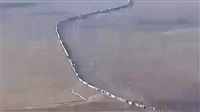
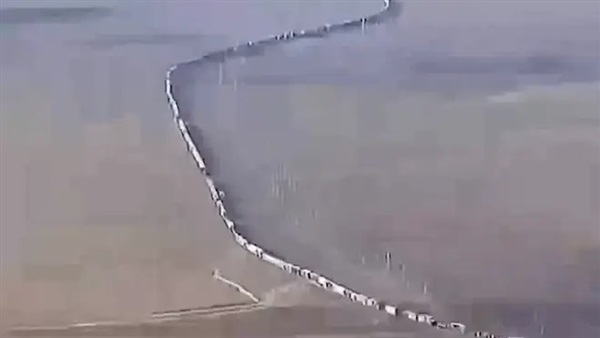
Video footage from a major transit corridor carrying goods from China shows approximately 1,200 lorries trapped in a 26-mile (42-kilometre) queue, illustrating the growing logistical challenges confronting the Islamic Republic.
At the Yalama border crossing between Kazakhstan and Uzbekistan, more than 1,000 vehicles have been waiting to cross, with some drivers spending several days in increasingly difficult conditions, according to The Telegraph.
The congestion offers a striking illustration of Iran’s struggle to replace maritime imports with overland transportation, as alternative trade corridors come under mounting strain.
US Naval Blockade Forces Iran to Reroute International Trade
Since US President Donald Trump imposed a blockade on Iranian ports, the country’s principal channels for transporting bulk commodities, heavy cargo and containerised goods have been severely restricted.
Importers have consequently redirected shipments through Kazakhstan, Uzbekistan, Pakistan, Turkmenistan and Turkey. Iranian officials acknowledge, however, that these overland routes lack sufficient capacity to accommodate the volume of goods previously transported by sea.
Amir Roshanbakhsh, an official with Iran’s Trade Development Organisation, said the number of lorries waiting at one border crossing had increased from approximately 200 to 1,200.
The financial consequences have been equally significant.
Majidreza Hariri, head of the Iran-China Chamber of Commerce, said transporting a container that previously cost approximately $3,000 (£2,294) by sea now costs around $12,000 (£9,177) by land.
He estimated that the transition to overland transportation had added approximately $18 billion (£13.7 billion) to Iran’s trade costs.
Perishable commodities face additional difficulties. According to one shipping agent, some fresh produce remains stranded in China because customs restrictions in Turkmenistan and Kazakhstan prevent its onward transportation.
The United States is also believed to be pressuring neighbouring countries to restrict cross-border trade with Iran through Task Force Iron Gate, established approximately two weeks earlier to increase pressure on Tehran during mediated negotiations aimed at ending the conflict.
Border Congestion Disrupts Trade and Drivers’ Livelihoods
The logistical disruption extends beyond Central Asia, with lengthy delays also reported at Iran’s Bazargan border crossing with Turkey.
Some drivers have reportedly waited weeks to complete their journeys, facing deteriorating working conditions and declining incomes.
Mohammadreza Shiri, a lorry driver with 15 years of experience, said he had never encountered comparable disruption and had already been stranded for five days.
Another driver, Akbar Sedighi, reported that his earnings had fallen to approximately half their previous level, while others described spending extended periods inside their vehicles without access to adequate sanitation facilities.
The experiences of these drivers illustrate the broader economic consequences of the US naval blockade of Iran, which are increasingly affecting workers and businesses throughout regional supply chains.
Iran’s Inflation Reaches 84% as Household Costs Surge
The disruption to international trade is intensifying Iran’s domestic cost-of-living crisis.
Prices for vegetables, pulses, dairy products and housing have increased substantially, while Iran’s central bank reported that urban inflation had risen for an 18th consecutive month.
The point-to-point inflation rate reached approximately 84%, meaning that households were paying around 84% more for the same basket of goods than a year earlier.
One Tehran resident told The Telegraph that he had begun stockpiling food as prices continued to rise.
The cost of four bottles of cooking oil reportedly increased from 3.05 million tomans (£8.50) to 3.35 million tomans between Saturday and Monday.
Meanwhile, the average daily salary stands at approximately one million tomans (£2.80), with wages remaining unchanged across much of the country since the war began on February 28.
To protect domestic food supplies, Iranian authorities have suspended exports of tomatoes, onions and potatoes until further notice, citing prevailing market conditions and the need to maintain domestic availability.
President Masoud Pezeshkian acknowledged that rising prices were a consequence of the blockade, explaining that longer transportation routes had increased the final cost of imported goods
.
He also acknowledged that restrictions on Iranian oil exports had significantly reduced national revenue, describing the economic crisis as the result of deliberate American pressure.
Pharmaceutical Shortages Threaten Iran’s Healthcare System
The humanitarian consequences of the economic disruption are becoming particularly apparent in Iran’s healthcare sector.
Parents have reportedly visited multiple pharmacies searching for influenza vaccines for their children. Iran’s pharmacists’ association said the vaccines had not yet reached the distribution network despite the beginning of the vaccination season.
Health Minister Mohammad-Reza Zafarghandi confirmed that pharmaceutical prices had increased as raw materials previously transported by sea now had to be imported by air, substantially raising transportation costs.
He also reported that 16 pharmaceutical factories and more than 70 hospitals had been struck during the war.
Iranian legislator Hossein Abdoli described the situation as a pharmaceutical siege under wartime conditions, warning that restrictions could directly endanger patients and undermine the healthcare system.
“The health of the people must never be turned into a tool of political or economic pressure,” Abdoli said.
The shortages highlight how disruptions to international commerce can extend beyond economic indicators, affecting access to essential medicines and medical services.
Electricity Rationing Adds to Iran’s Economic Difficulties
Iran’s energy sector is also experiencing mounting difficulties as the government struggles to provide sufficient fuel to electricity-generating facilities.
Tavanir, the state electricity company, has introduced rolling blackouts, initially lasting up to two hours every other day.
The restrictions could increase to two hours daily if colder weather places additional pressure on the national electricity network.
President Pezeshkian was filmed working in a dimly lit office while wearing a winter coat, encouraging citizens to conserve electricity and continue their daily activities with limited lighting and warmer clothing.
The power shortages add another layer of hardship for Iranian households already struggling with rising food prices, stagnant wages and restricted access to essential goods.
Tehran Debates Response to the US Naval Blockade
As economic conditions deteriorate, some Iranian political figures and media organisations have advocated confronting the US naval blockade of Iran directly.
The semi-official Fars news agency has invoked Fereydoun, a mythical hero of Persian literature who defied an obstacle imposed by forces loyal to the tyrant Zahhak, as a symbolic reference to resistance against American restrictions.
The analogy has been used in discussions about a potential Iranian challenge to the blockade.
However, Tasnim, a news agency closely associated with the Islamic Revolutionary Guard Corps (IRGC), stressed that no Iranian official had announced or confirmed such a plan.
The agency nevertheless maintained that Tehran would not accept the blockade indefinitely.
Ali Yazdikhah, a Tehran politician, also warned that continued restrictions on Iranian oil exports could lead to retaliation against Gulf countries, including the United Arab Emirates, Kuwait, Bahrain and Saudi Arabia.
These statements raise concerns about further regional escalation, although they do not establish that Tehran has authorised a military response.
Mounting Economic Pressure Leaves Iran Facing an Uncertain Future
Nearly nine months into the US-Iran war, the consequences of disrupted maritime trade are becoming increasingly visible across Iran’s economy.
Rising transportation costs, accelerating inflation, pharmaceutical shortages and electricity rationing are placing substantial pressure on households and businesses, while alternative trade corridors struggle to compensate for lost maritime capacity.
Although Washington is seeking to use economic pressure to secure concessions from Tehran, whether these measures will produce a negotiated settlement remains uncertain.
For the lorry drivers stranded at the Yalama crossing, however, the immediate consequences are already clear. As another night approaches, the queue stretches beyond sight, and the prospect of several more days of waiting remains a reality.