Chinese Military Decoys Help Russia Protect Its Equipment in Ukraine War
Tuesday 24/November/2026 - 04:31 PM
Ahmed Seif El-din
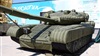
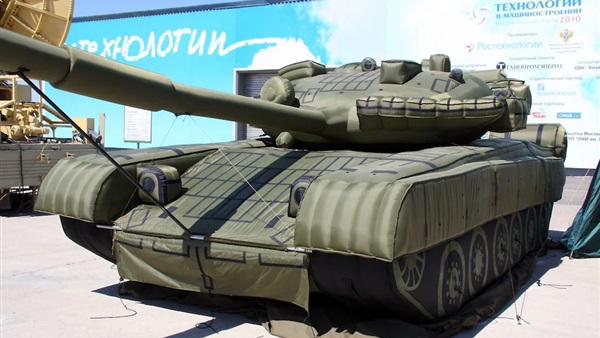
Low-cost inflatable aircraft, tanks and other imitation military equipment are becoming increasingly important in Moscow’s war effort, highlighting China’s controversial role in supplying dual-use goods to Russia.
Chinese military decoys are playing an increasingly significant role in Russia’s war against Ukraine, as Moscow seeks to protect valuable military equipment amid the growing use of reconnaissance drones and precision weapons.
What initially appears to be a collection of Russian fighter jets and helicopters at an airfield may, upon closer inspection, consist entirely of inflatable replicas.
An investigation by The Telegraph has identified advertisements on Chinese and Russian e-commerce platforms offering imitation military aircraft and other equipment, highlighting the commercial networks supporting Russia’s battlefield deception efforts.
Some inflatable aircraft reportedly cost only a few hundred dollars, making them considerably less expensive than the military equipment they are designed to imitate.
Chinese Manufacturers Expand Military Decoy Production
The investigation identified several Chinese suppliers advertising inflatable military equipment to international customers, including businesses operating under the Gauss name.
The companies appear to operate through several associated brands, including Gauss Intelligent Equipment, Gauss Inflatables, Jiangxi Gauss and Hangzhou Gauss.
Their advertised products include replicas of aircraft, tanks, artillery and other military equipment, alongside imitation military facilities.
Promotional videos describe camouflage and deception as increasingly important elements of modern warfare, while claiming that the company's products have been tested under battlefield conditions.
Gauss advertisements also highlight manufacturing facilities covering approximately 16,000 square metres, suggesting substantial industrial production capacity.
However, the company's claims regarding the performance and battlefield effectiveness of its products have not been independently established.
Robert Tollast, a land warfare research fellow at the Royal United Services Institute (RUSI), said the relatively uncomplicated nature of inflatable manufacturing could enable suppliers to produce substantial quantities.
He also suggested that significant volumes of such equipment could be entering Russia from China, although the precise scale of these shipments remains uncertain.
Reconnaissance Drones Increase the Importance of Military Deception
The proliferation of reconnaissance drones has fundamentally changed battlefield surveillance during the Russia-Ukraine war, making the concealment of large military assets increasingly difficult.
Michael Kofman, a senior fellow at the Carnegie Endowment for International Peace and an expert on the Russian and Ukrainian armed forces, said widespread aerial surveillance had increased the importance of military decoys.
For Ukraine, the growing presence of Chinese military decoys presents an additional challenge amid continuing concerns over ammunition availability and the financial cost of sustaining military operations.
The issue remains significant despite the Trump administration’s approval of a $2.1 billion (£1.6 billion) weapons deal for Ukraine.
Kyiv has also incorporated military decoys into its own defence strategy, including imitation tanks constructed from plywood.
The use of such equipment by both sides illustrates how traditional military deception has retained its relevance despite rapid advances in surveillance technology.
Chinese Suppliers Highlight the Ambiguity of Dual-Use Products
The investigation also identified promotional material featuring a woman named Sheena, who described herself as a manufacturer of inflatable recreational products rather than an arms dealer.
In one widely circulated social media post, she claimed to have received an order for 500 tank-shaped inflatables in March, followed by requests for replicas of aircraft and other military vehicles.
She maintained that she was unaware of the intended purpose of the products.
Neither Gauss nor Sheena immediately responded to The Telegraph’s requests for comment.
Analysts suggest that the commercial classification of such products illustrates the difficulty of distinguishing conventional civilian trade from goods with military applications.
Kofman noted that inflatable decoys are not inherently lethal products but can nevertheless provide clear military benefits.
Their sale therefore highlights the ambiguity surrounding dual-use goods and the challenges facing governments attempting to restrict commercial support for Russia’s defence industry.
Trade Data Points to Substantial Russian Imports
Russia has a longstanding history of employing military decoys, predating its full-scale invasion of Ukraine in February 2022.
According to Russian media reports, Moscow spent at least 48 million roubles (£443,000) on military inflatables in 2021.
At least some of those products reportedly originated in China, although a Russian government newspaper claimed that domestically manufactured alternatives were more convincing.
Russia’s defence ministry has previously awarded contracts for inflatable military equipment to domestic manufacturer Rusbal. Nevertheless, Russian media reports indicate that Chinese suppliers offer substantially lower prices.
Trade data compiled by Import Genius suggests that Russia has imported goods worth at least 10 billion roubles (£93 million) since February 2022 under a customs classification used by Chinese military inflatable manufacturers.
However, the figure cannot be treated as the confirmed value of Chinese military decoys supplied to Russia.
The same customs classification also covers legitimate sporting and outdoor equipment, including inflatable swimming pools. Consequently, the proportion of these imports intended for military use remains unclear.
China’s Dual-Use Exports Sustain Concerns Over Russia’s War Economy
Military decoys represent one element of a much broader commercial relationship between China and Russia that has attracted increasing scrutiny from Western governments.
According to the original report, China exported nearly $2 billion worth of goods classified as high-priority dual-use items during the first half of 2025, despite Western export controls.
Such products can have legitimate civilian applications while also contributing to military production and operations.
Kofman argued that extensive Chinese support had been instrumental in enabling Russia to sustain its war effort for more than four years.
The commercial relationship also provides Beijing with grounds to maintain that it is conducting legitimate international trade rather than directly supplying weapons to Moscow.
Bilateral trade between China and Russia reached approximately $230 billion in 2025.
Previous investigations by The Telegraph have examined Chinese supplies of helicopters, drones and metals used by Russia’s defence industry.
A separate investigation found that Chinese companies supplied components and materials, including aircraft engines and microchips, worth at least £47 million to sanctioned Russian drone manufacturers between 2023 and 2024.
These findings have intensified concerns over the effectiveness of Western sanctions and export restrictions targeting Russia’s military-industrial capabilities.
Beijing and Moscow Deepen Strategic Relations
Although China maintains that it is neutral in the Russia-Ukraine war, its political and economic relationship with Moscow has strengthened considerably since the invasion began.
Chinese President Xi Jinping has met Russian President Vladimir Putin in person at least nine times since February 2022.
In 2024, NATO criticised Beijing’s material and political support for Moscow, describing China as a “decisive enabler” of Russia’s continuing invasion of Ukraine.
More recently, Russia announced plans to strengthen military cooperation with China following bilateral discussions at the Asia-Pacific Economic Cooperation (APEC) summit.
The growing relationship has reinforced Western concerns that Beijing’s economic and industrial support is helping Moscow withstand international sanctions and sustain its military operations.
The emergence of Chinese military decoys as another component of this relationship highlights the increasingly blurred boundary between civilian manufacturing and military assistance.
While inflatable replicas are not conventional weapons, their military applications demonstrate how relatively inexpensive commercial products can acquire strategic significance during a prolonged conflict. However, the precise scale of Chinese decoy deliveries, their battlefield effectiveness and the extent of direct Chinese government involvement remain uncertain.