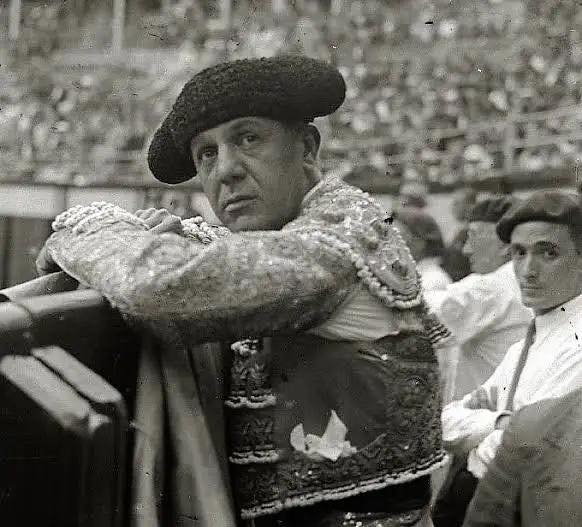
The Matador… Lorca’s Elegy… and
the Rhythm of At five in the afternoon
Many of my sons and friends in
Egypt and Paris have asked me about the secret behind my decision to begin
writing a daily column titled “At five in the afternoon”: What is the
significance of that timing? Does it have anything to do with what some
ignorant people have begun to repeat? Do such trivial positions tempt someone
like me to write with such intensity that I decide it must become a daily
article or appearance?
And because a human being has
come to be required to explain himself every time he ventures to dive a little
into his own depths—at a decisive moment in life, a moment when dreams turn
into an elegy and age into a standing pine tree bearing witness to what remains
of our blood—I felt compelled to tell you the story of my friend Lorca, and of
the greatest poetic text of the twentieth century.
Did Lorca have to explain himself
before he struck the greatest rhythm in Spanish poetry—and in world poetry
altogether: “At five in the afternoon”?
Ignacio:
“Lorca’s Elegy for His Friend,
the Matador Ignacio”
It is one of the greatest poems
of the twentieth century, if not the greatest of them all, and the rhythm of “At
five in the afternoon” was—and still is—the greatest in the history of poetry.
Federico García Lorca wrote it in
1935, as an elegy for his intimate friend, the famous bullfighter Ignacio
Sánchez Mejías, who died of his wounds after a bout in the arena.
Lorca is not writing about a
matador who died, but about a cosmic rite; a rite in which time freezes, the
hour becomes the hero, and death turns into a poetic rhythm—the most famous in
the history of twentieth-century poetry:
“At five in the afternoon.
It was exactly five in the
afternoon”.
This rhythm repeats like a
funeral bell, until time itself becomes the killer.
Ignacio, for Lorca, is not merely
a brave man, but a fated body walking toward its destiny, knowing that death is
possible… and yet entering the arena every day, carrying his silence and a few
lethal spears.
“I did not want to see him…
The blood overflows more than
memory.”
Lorca does not beautify violence,
nor does he celebrate death; rather, he transforms loss into music. It is a
poem not to be read, but recited; not to be understood by the mind, but to
strike the soul.
At five in the afternoon.
It was exactly five in the
afternoon.
A boy brought the white sheet
at five in the afternoon.
A trail of lime ready prepared
at five in the afternoon.
The rest was death, and death
alone.
The wind carried away the
cottonwool
at five in the afternoon.
And the oxide scattered crystal
and nickel
at five in the afternoon.
Now the dove and the leopard
wrestle
at five in the afternoon.
And a thigh with a desolated horn
at five in the afternoon.
The bass-string struck up
at five in the afternoon.
Arsenic bells and smoke
at five in the afternoon.
Groups of silence in the corners
at five in the afternoon.
And the bull alone with a high
heart!
At five in the afternoon.
When the sweat of snow was coming
at five in the afternoon,
when the bull ring was covered
with iodine
at five in the afternoon.
Death laid eggs in the wound
at five in the afternoon.
At five in the afternoon.
At five o'clock in the afternoon.
A coffin on wheels is his bed
at five in the afternoon.
Bones and flutes resound in his
ears
at five in the afternoon.
Now the bull was bellowing
through his forehead
at five in the afternoon.
The room was iridescent with
agony
at five in the afternoon.
In the distance the gangrene now
comes
at five in the afternoon.
Horn of the lily through green
groins
at five in the afternoon.
The wounds were burning like suns
at five in the afternoon.
At five in the afternoon.
Ah, that fatal five in the
afternoon!
It was five by all the clocks!
It was five in the shade of the
afternoon!
I will not see it!
Tell the moon to come,
for I do not want to see the
blood
of Ignacio on the sand.
I will not see it!
The moon wide open.
Horse of still clouds,
and the grey bull ring of dreams
with willows in the barreras.
I will not see it!
Let my memory kindle!
Warm the jasmines
of such minute whiteness!
I will not see it!
The cow of the ancient world
passed her sad tongue
over a snout of blood
spilled on the sand,
and the bulls of Guisando,
partly death and partly stone,
bellowed like two centuries
sated with threading the earth.
No.
I will not see it!
Ignacio goes up the tiers
with all his death on his
shoulders.
He sought for the dawn
but the dawn was no more.
He seeks for his confident
profile
and the dream bewilders him
He sought for his beautiful body
and encountered his opened blood
Do not ask me to see it!
I do not want to hear it spurt
each time with less strength:
the spurt that illuminates
the tiers of seats, and spills
over the corduroy and the leather
of a thirsty multitude.
Who shouts that I should come
near!
Do not ask me to see it!
His eyes did not close
when he saw the horns near,
but the terrible mothers
lifted their heads.
And across the ranches,
an air of secret voices rose,
shouting to celestial bulls,
herdsmen of pale mist.
There was no prince in Sevilla
who could compare to him,
nor sword like his sword
nor heart so true.
Like a river of lions
was his marvellous strength,
and like a marble torso
his firm drawn moderation.
The air of Andalusian Rome
gilded his head
where his smile was a spiked
of wit and intelligence.
What a great torero in the ring!
What a good peasant in the
sierra!
How gentle with the sheaves!
How hard with the spurs!
How tender with the dew!
How dazzling the fiesta!
How tremendous with the final
banderillas of darkness!
But now he sleeps without end.
Now the moss and the grass
open with sure fingers
the flower of his skull.
And now his blood comes out
singing;
singing along marshes and
meadows,
slides on frozen horns,
faltering souls in the mist
stumbling over a thousand hoofs
like a long, dark, sad tongue,
to form a pool of agony
close to the starry Guadalquivir.
Oh, white wall of Spain!
Oh, black bull of sorrow!
Oh, hard blood of Ignacio!
Oh, nightingale of his veins!
No.
I will not see it!
No chalice can contain it,
no swallows can drink it,
no frost of light can cool it,
nor song nor deluge of white
Lillie's,
no glass can cover it with
silver.
No.
I will not see it!
Stone is a forehead where dreams
grieve
without curving waters and frozen
cypresses.
Stone is a shoulder on which to
bear Time
with trees formed of tears and
ribbons and planets.
I have seen grey showers move
towards the waves
raising their tender riddle arms,
to avoid being caught by lying
stone
which loosens their limbs without
soaking their blood.
For stone gathers seed and
clouds,
skeleton larks and wolves of
penumbra:
but yields not sounds nor
crystals nor fire,
only bull rings and bull rings
and more bull rings without walls.
Now, Ignacio the well born lies
on the stone.
All is finished. What is
happening! Contemplate his face:
death has covered him with pale
sulphur
and has place on him the head of
dark Minotaur.
All is finished. The rain
penetrates his mouth.
The air, as if mad, leaves his
sunken chest,
and Love, soaked through with
tears of snow,
warms itself on the peak of the
herd.
What are they saying? A stenching
silence settles down.
We are here with a body laid out
which fades away,
with a pure shape which had
nightingales
and we see it being filled with
depth less holes.
Who creases the shroud? What he
says is not true!
Nobody sings here, nobody weeps
in the corner,
nobody pricks the spurs, nor
terrifies the serpent.
Here I want nothing else but the
round eyes
to see his body without a chance
of rest.
Here I want to see those men of
hard voice.
Those that break horses and
dominate rivers;
those men of sonorous skeleton
who sing
with a mouth full of sun and
flint.
Here I want to see them. Before
the stone.
Before this body with broken
reins.
I want to know from them the way
out
for this captain stripped down by
death.
I want them to show me a lament
like a river
which will have sweet mists and
deep shores,
to take the body of Ignacio where
it looses itself
without hearing the double
planting of the bulls.
Loses itself in the round bull
ring of the moon
which feigns in its youth a sad
quiet bull,
loses itself in the night without
song of fishes
and in the white thicket of
frozen smoke.
I don't want to cover his face
with handkerchiefs
that he may get used to the death
he carries.
Go, Ignacio, feel not the hot
bellowing
Sleep, fly, rest, even the sea
dies!
The bull does not know you, nor
the fig tree,
nor the horses, nor the ants in
your own house.
The child and the afternoon do
not know you
because you have died forever.
The shoulder of the stone does
not know you
nor the black silk, where you are
shuttered.
Your silent memory does not know
you
because you have died forever
The autumn will come with small
white snails,
misty grapes and clustered hills,
but no one will look into your
eyes
because you have died forever.
Because you have died for ever,
like all the dead of the earth,
like all the dead who are
forgotten
in a heap of lifeless dogs.
Nobody knows you. No. But I sing
of you.
For posterity I sing of your
profile and grace.
Of the signal maturity of your
understanding.
Of your appetite for death and
the taste of its mouth.
Of the sadness of your once
valiant gaiety.
It will be a long time, if ever,
before there is born
an Andalusian so true, so rich in
adventure.
I sing of his elegance with words
that groan,
and I remember a sad breeze
through the olive trees.
Yes, great men die, and their
dreams die at five in the evening. I saw my blood on the roads, like Ignacio’s,
flowing, and Lorca sets the time to five in the evening; Lorca turns time into
a tragic hero, making the rhythm the most famous in the history of poetry.
Lorca turns blood into language, not spectacle, and elevates the matador from a
passing event into a complete poetic legend. Do you understand now?!
It remains for me to tell you my
own story with the La Malagueta bullring, where Ignacio died; I visited it in
August 2018. It is located in the coastal district of La Malagueta, a few
minutes’ walk from the port of Málaga. I arrived there by sea, coming from
Tangier, that beautiful coastal city in Morocco.
The arena, with its circular
stands, red in color, and its green mountainous backdrop—the hills of Málaga
overlooking the city—is located in the Andalusia region and bears an Andalusian
character. It was built in 1876 and can accommodate nearly fourteen thousand
spectators. Every August it hosts the city’s most important festival, the Feria
de Málaga, celebrating the city’s national day.
And the La Malagueta arena,
despite being nothing more than a circle of stone and red sand, is, in Lorca’s
eyes, a city of light and sea, hosting a rite that knows no mercy; a poetic
altar: blood there is not a detail but a language, and the hour is not a time
but a fate, turning the city into a funeral hymn where the human dies and the
rhythm remains.
When I entered the arena, I did
not see the horseman (the matador) who came to greet us in the front row;
instead, I saw Ignacio collapsing, drenched in his blood. The clock did, in
fact, point to five in the evening when the performance began. I turned my face
away, fearing a repetition of what had happened to Ignacio before my eyes that
day, but I was surprised by my deep sympathy for the bull; that creature of
mythical strength, which does not know how to employ it except in one
direction. Every time it charged toward the red flag, it knew the matador would
plant a spear in its body, yet every time it hoped to turn the matador into
Ignacio’s fate… spear after spear, until the bull collapsed, drenched in its
blood.
I do not know why I could not
look into the eyes of the matador who returned to greet us at the end of the
fight; I did not applaud him. I released my sorrow and left, never to return
again, but I kept the rhythm of “five in the evening.”
Málaga: At five in the afternoon,
Cairo time