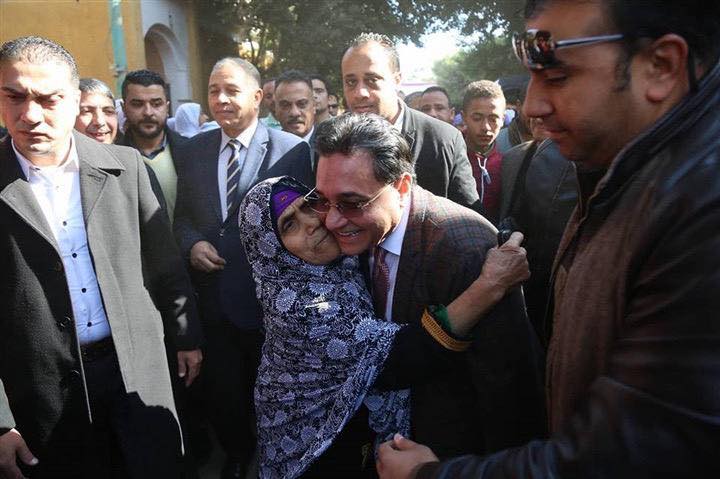
Aunt Fatima
My colleague, the photojournalist Alaa Al-Qassas, did not know, as he was taking that expressive photograph, that he was capturing an image of me with “my Aunt Fatima,” my mother’s sister—who went out despite illness, advanced age, frailty of the bones, and failing eyesight, to receive me at the edge of the village with an embrace filled with love and longing for her son whom she had not seen for three full years.
It was not negligence on my part; I remained in contact with her, with her children, and with the entire village throughout that period—almost every day of the week, whether I was inside Egypt or abroad.
My aunt received me, indifferent to those around me who tried to keep her away lest she be harmed by the severe crowding around me. She insisted on holding my arm until I left the village.
This simple woman—my mother as well—and all the kind faces I saw that day, those who embraced me with their hearts before their arms, are the ones who granted us—people and a homeland—the kiss of life when we needed them, after the battle to cleanse the nation on June 30, 2013.
These are the people who did not groan on Facebook or Twitter, who demanded nothing; on the contrary, we heard nothing from them throughout those years, even as we tried to offer them what might help them endure life’s circumstances, as a right owed to them by us. From them we heard only their famous phrase, which has accompanied me since childhood:
“We’re managing, my son.”
They say it at all times and in all circumstances: in poverty and in wealth, in health and in illness, in success and in failure. Yes—managing, because of you, because of your restraint, and because of your sense of dignity and self-respect.
It was an ordinary day in January 2019 when I decided to visit my birthplace after an absence of three years, divided between Cairo and several European capitals. I was eager to see my family, the neighbors of our house, childhood friends, and the walls of the old home—which I had rebuilt anew, yet it felt desolate compared to what it once was; the warmth of winter and the coolness of summer had left it, as had the scent of those who once lived there.
I was mistaken, but I was driven by what we call in our country “people’s talk,” and by my mother’s wish—may God have mercy on her. At that time, my mother had gone to Cairo to stay near those monitoring her health after her body weakened, her bones grew frail, her head flared white with age, and she was no longer able to stand or walk once her knees failed her.
Large crowds I had not expected received me, with drums and the traditional reed flute. I had not imagined such a reception, but I later learned that they had followed my electoral battle in 2015 and were proud that their son had swept a district like Dokki and Agouza from the first round, though he was the son of a remote village in Upper Egypt.
Ululations rose, men cheered, and women who had helped raise me hurried to embrace me. Here was their son, who had left the village as a child to attend Al-Nasser Primary School in the city of Minya, then Al-Ittihad Preparatory School, then secondary school, and after that Cairo University—returning to them as a member of parliament under the dome.
I felt hearts before eyes, and before bodies, embracing me. Words from the heart, preceded by tears—from simple people, like the silt of the Nile, and the fragrance of dates and henna.
From afar, the sound of the traditional flute drifted to my ears, welcoming me—the very sound I had so often heard when elders came to our village during election seasons.
I wept as though I were a child. I embraced everyone, and for the first time in many long years I felt my heart tremble—rising and falling, singing and laughing, speaking and falling silent—in a moment I will never forget as long as I live.
My Aunt Fatima kept hold of me; she did not let go of my hand. Perhaps she feared my departure, as I so often do. I reassured her that I would stay for hours, perhaps a day or two. But by day’s end I broke my promise to her and returned to Cairo. Still, the warmth of her hands—like my mother’s—has not left mine.
Paris: five o’clock in the evening, Cairo time.