Al-Ṣaḥḥāf… and “the simpleton they handed a drum”
Al-ṣaḥḥāf, linguistically, is an intensive (hyperbolic) form derived from the verb ṣaḥḥafa (Form II), on the pattern faʿʿāl. In language, it denotes frequent taṣḥīf—that is, altering a word from its correct form—or the habit of doing so, or even skill in it.
Thus one might say, for example: this copyist is a muṣaḥḥif; as for that one, he is a ṣaḥḥāf—meaning that hardly any text escapes distortion at his hands.
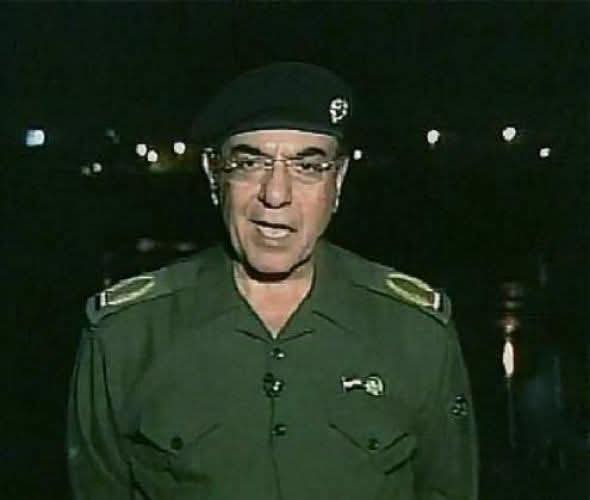
In modern history, during the American and British invasion of Iraq in March 2003, we came to know a man who embodied something even closer to precision than that hyperbolic form: Mohammed Saeed al-Ṣaḥḥāf, famous for his use of the term “the al-ʿulūj,” which he applied to the American forces that invaded Iraq in 2003, when he was serving as Iraq’s Minister of Information.
Mohammed Saeed al-Ṣaḥḥāf played a major role in the course of events through the media war he led—one I witnessed firsthand. I followed the daily developments of the war during that period on the ground in Baghdad. Al-Ṣaḥḥāf was constantly appearing at press conferences in which he announced successive victories by Iraqi forces, even as U.S. ground troops were advancing toward Baghdad.
At his final press conference, before the fall of Baghdad on April 9, 2003, while American forces were occupying the Republican Palace and key ministry buildings in Baghdad—and while Saddam Hussein was meeting a number of citizens during a surprise tour that amounted to his last public appearance—the Americans were officially announcing the occupation of Baghdad by coalition forces. At the same time, Saddam and several members of his family and close aides had disappeared, their whereabouts unknown, until he was captured on December 13 following a tip from a citizen, while he was hiding in a hole underground.
So that we may recall that al-Ṣaḥḥāf together, let me convey to you some of the statements I personally heard from him a few days before the fall of Baghdad:
The Americans are “now committing suicide by the thousands on the walls of Baghdad.”
Do not believe anything! We will chase these scoundrels all the way to London!
After we finish off those ʿulūj, we will announce that with facts and figures.
We are now trying to exhaust them, until the leadership decides the time and the method for cleansing our region of their defilement.
Our Iraqi fighters are slapping those gangs in the face, and when they flee, they will kick them in their backsides.
We will drive those deceitful mercenaries into the swamp.
When they reach the walls of Baghdad, we will encircle them and slaughter them… wherever they go, they will find themselves surrounded.
The situation is excellent. They are trying to approach Baghdad, and I believe their grave will be there.
The ʿulūj are committing suicide by the hundreds on the walls of Baghdad.
They are like a snake, and we will cut it into slices.
Those statements thundered forth from al-Ṣaḥḥāf while American forces were advancing on all fronts. The man gave us a lesson even stronger than that of Ahmed Saeed, the famous broadcaster of Sawt al-Arab during the June 1967 war, when he was announcing that our aircraft were pounding Tel Aviv, while our planes had been struck as they lay sleeping on the runways, without moving a single meter.
Thus al-Ṣaḥḥāf became the successor to Ahmed Saeed, a symbol for people of that ilk—the so-called Facebook “braves” and the kidnapped bodies—who draft decisions at night and announce them as if they were real victories, all the while knowing that their end will be the dustbin of history, after the great Egyptian judiciary slaps them all across the face.
The relationship between all these ṣaḥḥāfūn and the famous Egyptian proverb “hablah wamsakūhā ṭabla” (“a simpleton they handed a drum”) is a close one. It is an old proverb that Egyptians still use to express entrusting a matter to those unfit for it. The simpleton, when she holds the drum and beats it, imagines herself a skilled and creative musician with a distinctive performance, unaware—though everyone else clearly knows—that she produces nothing but discordant noise, admired only by others like her among the discordant.
These people, in our political, social, and trade-union life, unfortunately are many—just like al-Ṣaḥḥāf and Ahmed Saeed—especially what is known as electronic flies that have spread across social-media pages. They shout with whoever shouts, croak with whoever croaks, and commit taṣḥīf with the ṣaḥḥāf, without any real information, or legal or scientific references for what they say—indeed, without any controls governing their actions and words, or any fixed standards by which they weigh matters, far from personalization and demonization. They have turned our lives into farcical plays whose jokes only they laugh at. To all of them we say: the time of reckoning has drawn near, and your fate will be, God willing, like the fate of al-Ṣaḥḥāf and “the simpleton they handed a drum”—in the dustbin of history.
Paris: five o’clock in the afternoon, Cairo time.