The Banks of Longing
I write every day to strangers,
and to exile,
to a wall that ruminates on longing,
to a woman crouched in a corner of fear,
to a child fleeing those who come from afar,
to the elderly in the alleyways of sorrow,
and to the folded papers tucked between little girls’ books, telling love stories,
to braids,
to the sun,
to the air when asthma patients exhale it,
to the dead on the paths of loneliness,
to the weak,
to the hungry,
to me.
I write to myself when the vessels of memory tear at me,
and sail me toward a horizon edged with silence.
I was ash-gray in passion,
and southern in love I still am,
lost upon the earth,
still,
I do not find myself.
Yet every evening,
I summon the faces that linger on the bank of the soul,
and I begin to remember…
Counselor Salah Hafez:
My heart now quarrels with you, and half the road and half the loaf… and half the road and half the distance between my heart and innocence.
Now the taste of flowers quarrels with you,
and the silence of fields,
and the sound of rain.
There you are, drawing for me a path of embers to walk alone upon… The path of God once gathered us, and the stations of His saints were refuge and escape… so where to? Where to, O exile, roaming between evenings and dawn, poured out as a wandering tear.
You alone once drew for me a path of joy to walk upon with my heart; I would open a door for lovers and close all the roads of anguish…
So what comes after you?
All the appointments between us you deemed trivial, and all the calls of lovers were blown away by the winds…
You left them behind and ran alone toward your final appointment… That was not what we agreed upon… We used to think together, read together, and roam all the lovers’ paths together…
Aid… aid… aid… So it is aid, then—that unknown you ran after alone, desiring it alone, knowing its sweetness and its worth alone, and sipping from it your final draught alone… Did they meet you there? How did they receive you, my friend, as you ran toward them with open arms?
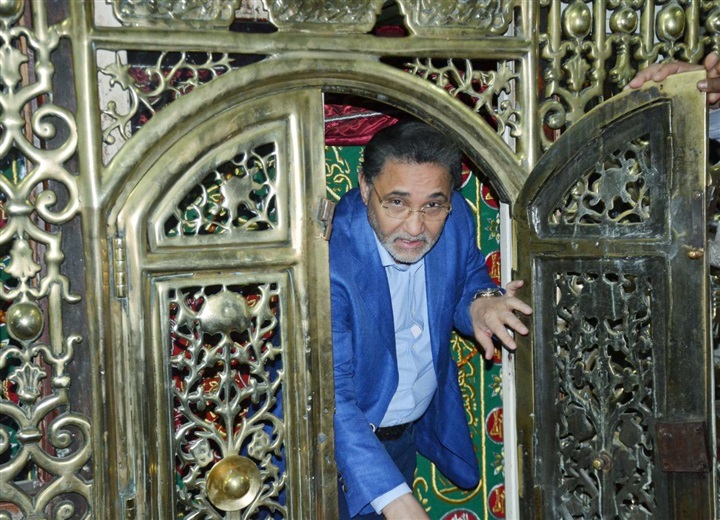
I remember, in our last visit to the courtyard of Sidi Abu al-Hasan al-Shadhili, you asked me to climb alone to where the shaykh used to ascend… The heart that had so often intended to climb betrayed you… You told me: the heart muscle has weakened; yet it still knows the path of love and walks the path of lovers. I kissed your cheeks and told you I would pray for you there in Humaythirah—you’ll see—and we laughed…
And at the shrine of al-Sayyid al-Badawi we wept as we had never wept before… You told me: remember… God will grant you a mighty victory… And we departed…
Now you run alone toward them and leave me. God, God, O Uncle Salah—God, God, O Uncle Salah. Greet the lovers there and convey to them a message in my blood; tell them I long to meet, that I have melted. Pray for me there, for you are now the close messenger, and I am the disciple who waits.
Uncle Muhammad:
Twenty years or more—he left me only once. He had been angered by the behavior of one of those working with me, left and went away, but he could not work for anyone else. He soon returned, took me into his arms as was his habit, and said: “Whoever works for you finds it hard to work for anyone else, no matter how high their standing.”
Bambuti from Alexandria, fluent in Greek, and cooking like the finest chefs in the world. Last year he came to me weeping and shouting: “My firstborn son has a very high fever; they admitted him to the hospital.”
I rushed there. My flight was hours away, and I was heading to an important conference in Munich. I sat with him in the hospital until morning, but the young man breathed his last. From that day Uncle Muhammad changed; he was no longer as he had been. His smile left him after he used to laugh at the smallest things until his eyes filled with tears.
“Life is short, Pasha,” he says to me, adding: “I married four times—Umm Alaa was the last. Two of them were from Alexandria.” I tell him: “Man, you’re seventy years old.” He replies: “No, I’m sixty-nine, Pasha. And we don’t live life twice.”
Uncle Muhammad was no longer the same after he bid farewell to his firstborn son, Alaa, and kept his three-year-old granddaughter with him, letting her mother remarry. He knew life had to go on, and that this girl was his flesh. When the accursed illness attacked his wife Umm Alaa, he spent more time at home caring for her, and he would say to me: “I’m afraid she’ll die before I get her an owned room, because the ceiling of the one we’re renting is about to fall.”
When I gave him enough to buy it and asked him months later, “What’s the news of the room—did you buy it?” he said to me, laughing: “Umm Alaa’s treatment matters more. We’ve grown old, and she served me a lot and spent her youth with me. She deserves to rest in her final days.”
I laughed and said: “So, in short, you squandered the few pounds?” He said: “For her, Pasha—she’s Umm Alaa, the love.”
Lately Uncle Muhammad withered and was no longer as he had been; his strength collapsed after his son’s death and his beloved’s illness. He no longer laughed as usual, and most of the time he forgot what I asked of him and drifted off often.
On one of my trips to Paris, Tarek, my office manager in Cairo, called me—his voice breaking over the phone—to tell me that Uncle Muhammad was ill. I asked: “The flu again? Won’t he quit cigarettes?” But Tarek paused, then surprised me: “No—this is the accursed disease, God keep it away from you.”
I told him: “Treatment is on my account, in the best places, Tarek. And whoever falls short with him or his wife—you know I’ll be very upset.”
I assigned a colleague to follow up with the Ministry of Health to track the case continuously with the hospital and the attending physician.
The last time I spoke to him on the phone, I joked: “Hey old man, know that if you don’t recover before I get to Cairo, I’ll look for someone else to cook for me better than you—I’ve had enough.”
Uncle Muhammad laughed and said: “I know—you’re saying that without your heart in it. You won’t be able to do without me or my food.” We laughed and ended the call. I got busy—until Tarek’s voice came again to say: “My condolences—Uncle Muhammad has died.”
Uncle Muhammad died, leaving me and leaving his beloved Umm Alaa… He returned as he once was—a child sharing with me a piece of bread, but not sharing with me the bitterness.
Paris: five o’clock in the evening, Cairo time.