Shadows of the Violet
Who, I wonder, carries now the glow of the violet
and the distant memories,
and runs after our old streets,
casting down the bag of my sorrow and moving on,
beyond the seas,
the houses,
beyond the paths of travel.
Who, I wonder, will grant me repose!
I return now a child,
and I dream again.
My home was here.
These far roads
were once here.
This evening was here,
and I was the rain.
The houses lay shattered in the eyes of the sky,
and I was the glow.
I was not joyful,
yet I smiled.
Ah—who will grant the eyelid tears
and strip from me the garments of frailty!
Your eyes awakened me this morning.
Between me and the beloved country
there was an old wound.
I was not feeling your face;
I was watching those borderlands,
while my face wrapped the homeland.
Ah—who will now set this bag down
from my shoulder,
restore the pulse to me,
and the country,
the seasons,
that beloved one,
my mother, and my companions…
Mohamed Hashem…
Eyes of violet, and a back bending toward the water as if it were a night’s crutch, defying the wave of morning and breaking.
Soft music in the place; cigarette smoke; the aroma of aged sweat; walls faded in color; titles of sea moss; and cosmic visions shining through the forgotten wall in exile.
And I—the one departing among the notebooks of history and the sun—return from streets that devoured my soul, to lean upon him.
I am the forgotten one in memory…
At that time, I was waging a major battle against religious-violence groups in Egypt. That was not my biggest problem. The greater problem came when I discovered a major deal between those groups and state security agencies. The headline of Al-Ahali newspaper then, August 1998, was shocking:
“Deal Between the Government and Violent Groups.”
Shocks, episodes, and headlines followed, until I met the great Milad Hanna at his home in Mohandessin, accompanied by my late friend Dr. Gamal Ismail. He opened by asking me: Why haven’t you published a book about the battle you are fighting now and its details? Recording it has become the duty of the moment.
After long and extensive discussions, I left him, only to return the next day having finished the first chapter of the book Risk in the Deal Between the Government and Violent Groups.
After completing the book, the search began for a publisher with the courage to release such a title. Some refused; others apologized. The subject was sensitive and dangerous, and the information carried by the book’s lines—and the analysis it pursued—portended a major battle that could bring down author and publisher alike.
Someone pointed me to a newly founded publishing house beside my office on Suleiman Pasha Street. We met for the first time at Dar Merit, in the summer of 1998. Mohamed Hashem welcomed the book with the joy of a child and spoke with the brilliant Ahmed El-Labbad to design the cover.
He did not stop there. With captivating ingenuity, he asked me to change the title. I had chosen The Danger in the Deal Between the Government and Violent Groups for my study. He chose Risk in the Deal Between the Government and Violent Groups, saying: danger is fate, but risk is a human act. I smiled. The printing presses turned with the new title; the book saw the light. And what I had expected happened: Mohamed Hashem was arrested, and the first copies of the book were confiscated… and what befell me befell me?!
Yet other copies had already been leaked to a number of journalists—Hashem’s friends—and publication continued inside and outside Egypt. Hashem and the book were released. I emerged with a few threats—and my car burned in front of my home on Street 9 in Mokattam.
A bond of blood began between Hashem and me, witnessed by the greats: Ahmed Fouad Negm, Sayed Hegab, Sayed Khamis, Osama Anwar Okasha, and others.
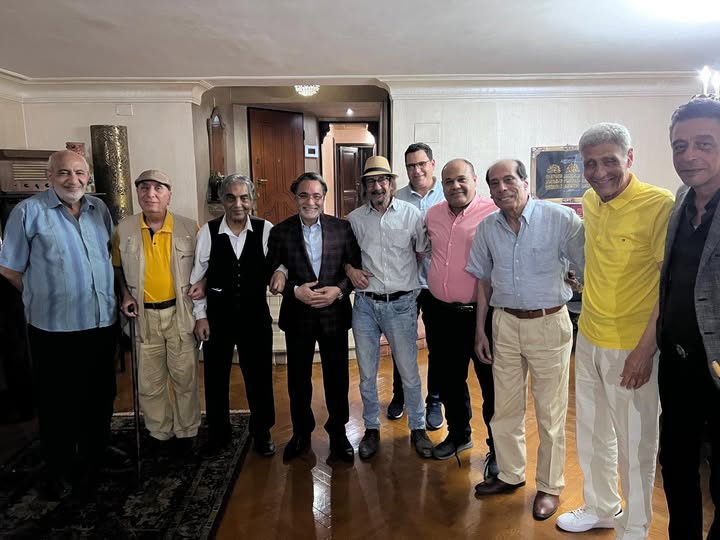
Its last testament was the meeting that brought us together during my most recent visit to Cairo. We sat in my home in Agouza, with Mohamed Saeed and Mohamed Farag, leaders of the Tagammu; Mahmoud Hamed; Dr. Yousry Abdullah; colleague Magdy El-Dakkak; Tamer Afandi; Tarek Ali; and the famed ney player Edward—recounting some of Egypt’s history, our history and the history of the Left, sipping what remained of the coffee of the soul, while Edward played for us on the ney:
You rose—how beautiful its light, the sun of suns…
I fell in love and was undone…
I am the Egyptian, noble of both lineages…
The gathering ended on a promise of another meeting—one I was certain would take place—there, where Abu Al-Nogoum is, and our uncle Sayed Hegab, Osama Anwar Okasha, the great artist Salah El-Saadany, and others with whom we shared the Merit sessions, the Geryon nights, and the sidewalks and cafés of downtown.
Uncle Meshref Abu Hashish…
There is no journalist who went to Assiut to cover the incidents of terrorism in the 1990s and beyond who does not know Professor Meshref Abu Hashish, director of the Middle East News Agency in Assiut. Whoever was not fortunate enough to know the man missed much of the meaning of manhood, generosity, and ethics in their purest sense.
I came to know him in 1991, when I went to cover the events of Sanbo. On the margins of those events, I witnessed the blazing yet concealed conflict between its governor at the time, Major General Hassan Al-Alfi, and the National Democratic Party deputies led by their secretary-general in Assiut, Mohamed Abdel-Mohsen Saleh—against the backdrop of the deputies’ and the secretary-general’s siding with the then minister of interior, Major General Mohamed Abdel-Halim Moussa, against the governor. At that time, only two men stood with Hassan Al-Alfi: Meshref Abu Hashish and MP Mohamed Ahmed Hussein, then the representative of Assiut City. When I heard the story, I realized the extent of the injustice done to Governor Hassan Al-Alfi and the attempts by National Party men to besiege him in favor of rumors that nominated him as a replacement for Abdel-Halim Moussa—igniting a battle between the two men without the slightest apparent cause. Then I knew the man’s true mettle: an alloy of gold—he supports what is right and fears no reproach in God.
My relationship with Meshref Abu Hashish extended for many years without our meeting or even shaking hands, until news broke of the storming of my office in Dokki in 2014 by more than thirty-six armed men following the dispersal of the Rabaa sit-in. The man surprised me with his call—not to check on me, but to declare, in all sincerity, his readiness to come to Cairo with his family and stand before my office with their personal weapons to defend me and protect me, my family, and everyone working at the Gate. I thanked him and held the deed—and the doer—in the highest esteem. He continued to send me messages of affection and love from time to time. I may not have met him for thirty years or more, yet his image never left my eyes—a symbol of manhood, gallantry, and generosity.
Meshref Abu Hashish passed away before I could visit him as I had promised in Assiut. I was in Paris then. I found myself writing to his daughter and son, asking them to forgive me for not having asked about him all that time, and confessing to them that I loved him like a brother—and more—and that I am by their side, even if from afar, to repay some of his debt. Peace be upon you, Uncle Meshref. Greet our people there, and wait for me.
Paris: five o’clock in the evening, Cairo time.